Deity
Bastet
greek Ailuros
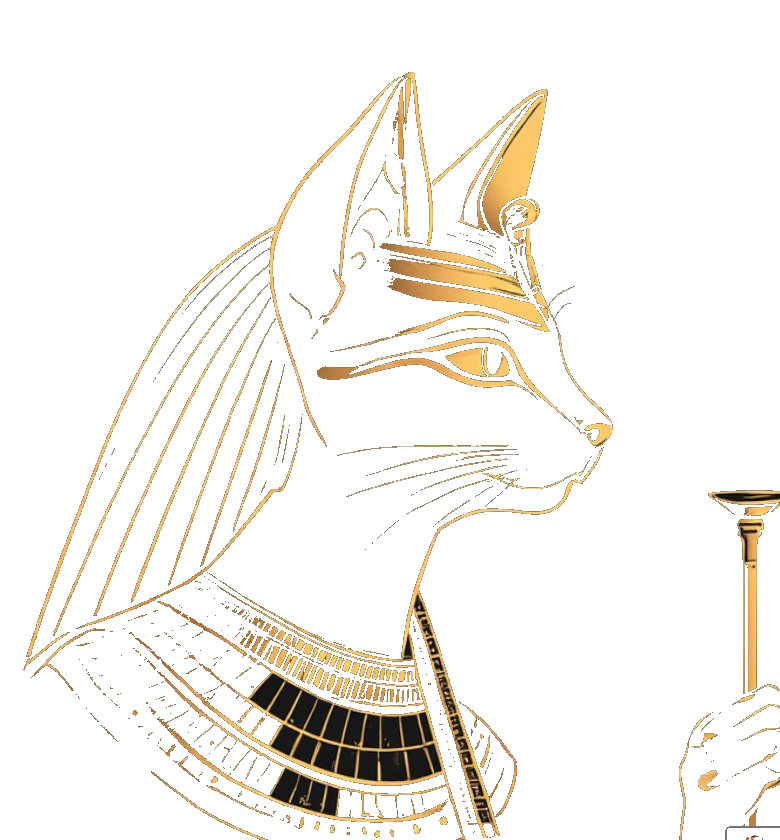
Gentle guardian with velvet paws and sheathed claws.She purrs in the hearth-light but never forgets the hunt.
Domains
Role
Bastet is the cat goddess of protection, fertility, home, and the domestic sphere, originally a fierce lion-headed warrior goddess who was gradually softened in later Egyptian theology into the familiar cat-formed deity. In her earliest attestations from the Old Kingdom, Bastet (or Bast) was depicted as a lioness and was virtually indistinguishable from Sekhmet, representing the protective and aggressive aspects of the sun. Over the course of Egyptian history, a theological differentiation occurred: Sekhmet retained the lion form and the destructive solar associations, while Bastet assumed the domesticated cat form and came to embody the gentler, protective, nurturing aspects of feline divinity. This transformation mirrors the domestication of the African wildcat in Egypt, one of the earliest instances of cat domestication in human history.
Significance
Bastet's theological evolution from lioness to house cat reflects broader changes in Egyptian religious sensibility and the increasing importance of domestic piety. As a protector of the home, she guarded against evil spirits, disease, and misfortune, and her image was placed in domestic shrines to ensure the safety and fertility of the household. Cats in Egypt were revered partly due to their practical role in controlling vermin that threatened grain stores and partly due to their association with Bastet. Herodotus reported that Egyptians mourned the death of a household cat by shaving their eyebrows, and that harming a cat was punishable by death. While these accounts may be exaggerated, the discovery of vast cat cemeteries confirms the extraordinary importance of cats in Egyptian religious practice.
Cult & Worship
Bastet's primary cult center was Per-Bastet (Bubastis, modern Tell Basta) in the eastern Nile Delta, where Herodotus described an annual festival that he claimed attracted 700,000 revelers — making it one of the largest religious celebrations in Egypt. The festival featured music, dancing, feasting, and the liberal consumption of wine, reflecting Bastet's association with joy, pleasure, and celebration. Archaeological work at Tell Basta has revealed the remains of a large temple complex and extensive cat cemeteries containing thousands of mummified cats deposited as votive offerings. Similar cat cemeteries have been found at Saqqara, Beni Hasan, and elsewhere, and the commercial production of cat mummies for pilgrims became a significant industry, with modern analysis revealing that many of these votive animals were purpose-bred kittens killed at a young age for mummification.
Mythological Narratives
Bastet's mythology is less extensively documented in narrative form than that of some other major deities, but her protective role is well attested in magical and ritual texts. She was identified as a daughter of Ra who could assume both gentle and ferocious forms, and the "Book of the Dead" includes spells invoking her protection for the deceased. In the "Legend of the Eye of Ra," Bastet can be understood as the pacified form of the solar Eye, the gentle state to which the raging goddess returns after her destructive fury is quenched. Magical papyri invoke Bastet as a protector against venomous snakes and scorpions, and amulets in her form were commonly worn by women and children seeking divine protection. Her festival at Bubastis served as a ritual celebration of the triumph of joy and life over fear and death, embodying the principle that the fierce protector transforms into the gentle companion once the threat has passed.
Symbols & Attributes
Sources & References
- The Complete Gods and Goddesses of Ancient Egypt (2003)
- Ancient Egyptian Religion (2002)
- The Routledge Dictionary of Egyptian Gods and Goddesses (2005)