Deity
Ra
greek Helioscoptic Re
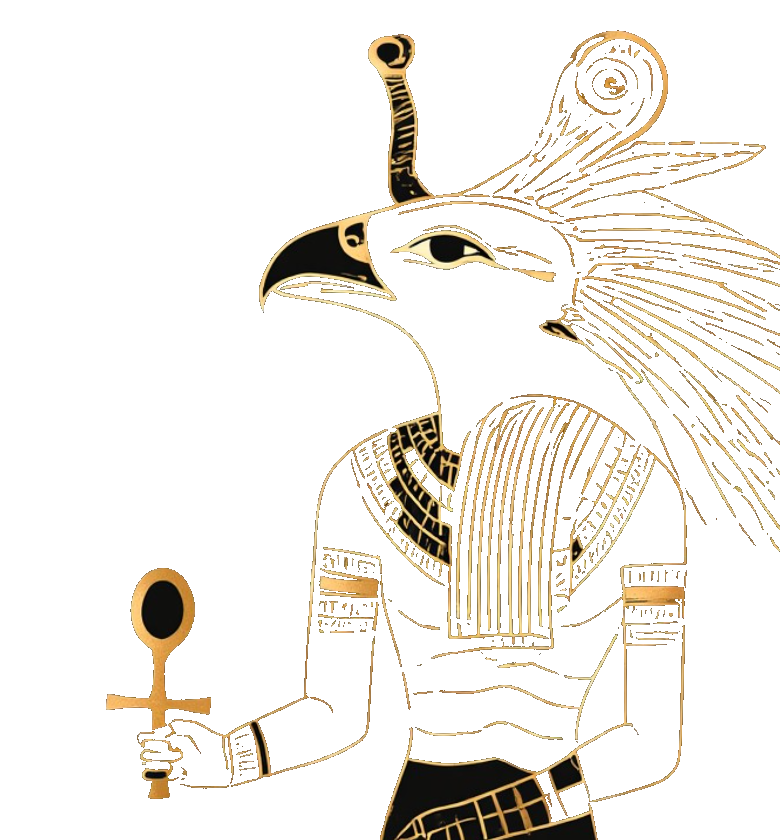
Lord of the blazing horizon, whose golden bark crosses the sky each day.He is the first light, the fire that names all things into being.
Domains

Role
Ra stands at the pinnacle of the Egyptian divine hierarchy as the supreme solar deity, the self-created god who brought light and order to the cosmos. In Heliopolitan theology, Ra emerged from the primordial waters of Nun, either upon the primeval mound (benben) or within the petals of a cosmic lotus, and through his first utterance called the world into existence. He is the creator of the gods Shu and Tefnut, the progenitor of the Ennead, and the divine model for pharaonic kingship. Every pharaoh bore the title "Son of Ra" from the Fifth Dynasty onward, establishing an unbroken theological link between solar divinity and earthly sovereignty that persisted for over two thousand years.
Significance
Ra's theological importance cannot be overstated: he was the organizing principle of Egyptian cosmic order. The daily solar cycle was understood as Ra's journey across the sky in his day bark (Mandjet) and through the perilous underworld in his night bark (Mesektet), a voyage that constituted the fundamental rhythm of creation. Each dawn was a renewal of the original act of creation, and each sunset a confrontation with the forces of chaos. Ra's syncretism with other gods, producing composite deities like Amun-Ra, Ra-Horakhty, and Atum-Ra, reflects the Egyptian theological tendency to layer divine identities rather than replace them, creating an ever-richer tapestry of solar symbolism.
Cult & Worship
Ra's primary cult center was Iunu (Heliopolis), known to the Egyptians as the "Pillar City," located at the apex of the Nile Delta near modern Cairo. Though almost nothing survives of the great temple of Ra at Heliopolis today, ancient sources describe it as one of the most magnificent religious complexes in Egypt, housing the sacred benben stone upon which the first rays of sunlight were said to have fallen. The Fifth Dynasty pharaohs constructed a series of sun temples at Abu Ghurob, featuring massive open-air altars oriented toward the sun and topped with squat obelisks, architectural forms that embodied Ra's theology in stone. The Pyramid Texts of the Old Kingdom, the oldest corpus of religious literature in the world, are saturated with solar theology, describing the deceased pharaoh's ascent to join Ra in his celestial bark.
Mythological Narratives
The most significant solar myth is the nightly journey through the Duat, described in funerary compositions such as the Amduat, the Book of Gates, and the Book of Caverns. Each night, Ra descends into the underworld and must navigate twelve hours of darkness, confronting the chaos serpent Apophis in a battle that threatens to prevent the dawn. The crew of Ra's bark, including Set, Thoth, and Isis, assist in repelling Apophis with spells, harpoons, and magical knives. Another key narrative, the "Destruction of Mankind" (preserved in the tomb of Seti I), describes how Ra, grown old and weary of human rebellion, sends his Eye in the form of Hathor-Sekhmet to punish humanity, only to relent and trick the raging goddess with beer dyed red to resemble blood. This myth explains both the origin of ritual beer offerings and the complex relationship between solar benevolence and destructive divine wrath.
Legacy
Ra's influence permeated virtually every aspect of Egyptian civilization, from royal titulary and temple architecture to funerary practice and artistic convention. The obelisk, one of Egypt's most recognizable architectural forms, was a petrified sunbeam sacred to Ra, and the capstone (pyramidion) atop both obelisks and pyramids was often gilded to catch the first and last rays of the sun. Akhenaten's religious revolution of the Amarna period, which elevated the solar disk Aten to sole divine status, can be understood as a radical purification of Ra theology stripped of its mythological accretions. Even after the decline of pharaonic civilization, solar worship from Egypt influenced Greco-Roman religion, with the cult of Sol Invictus bearing echoes of Ra's theological legacy.
Symbols & Attributes
Connections
Associated with Atum Ra and Atum merged as Ra-Atum, the evening and morning sun
Parent of Hathor Hathor called "daughter of Ra" and the Eye of Ra
Associated with Sekhmet Sekhmet is the wrathful Eye of Ra sent to punish humanity
Associated with Bastet Bastet is the gentle Eye of Ra, protector against evil
Associated with Ma'at Ma'at is the daughter of Ra, cosmic order sustaining his rule
Associated with Thoth Thoth serves as Ra's vizier, recording divine judgments
Rival of Apophis Ra battles Apophis each night in the Duat; eternal cosmic struggle
Associated with Heliopolis Heliopolis was the center of Ra's solar cult
Associated with Ankh The ankh represents the life-giving power of the sun
Associated with Bennu The Bennu bird is the ba (soul) of Ra, herald of creation
Associated with Sphinx The Great Sphinx was associated with the solar deity Horemakhet (Horus of the Horizon)
Associated with Sobek Sobek-Ra: the crocodile god merged with the sun god in some traditions
Featured in
The Contendings of Horus and Set
The eighty-year legal and physical battle between Horus and Set before the divine tribunal for the throne of Egypt.
cosmic-battlekingshipjustice
Ra's Journey Through the Duat
Each night the sun god Ra travels through the twelve hours of the underworld, battling the chaos serpent Apophis before being reborn at dawn.
solar-cycledeathrebirthchaos
The Creation at Heliopolis
From the dark waters of Nun, Atum rose upon the primordial mound and through his own will brought forth the first gods, creating the Ennead of Heliopolis.
creationcosmogony
The Destruction of Mankind
When humanity plots against the aging Ra, he unleashes the Eye of Ra as Sekhmet to punish them, then saves the survivors by tricking her with beer dyed red as blood.
divine-judgmentwrathmercy
Sources & References
- The Complete Gods and Goddesses of Ancient Egypt (2003)
- Conceptions of God in Ancient Egypt (1982)
- The Oxford History of Ancient Egypt (2000)