Deity
Sekhmet
greek Sachmiscoptic Sakhmiegyptian Sakhmet
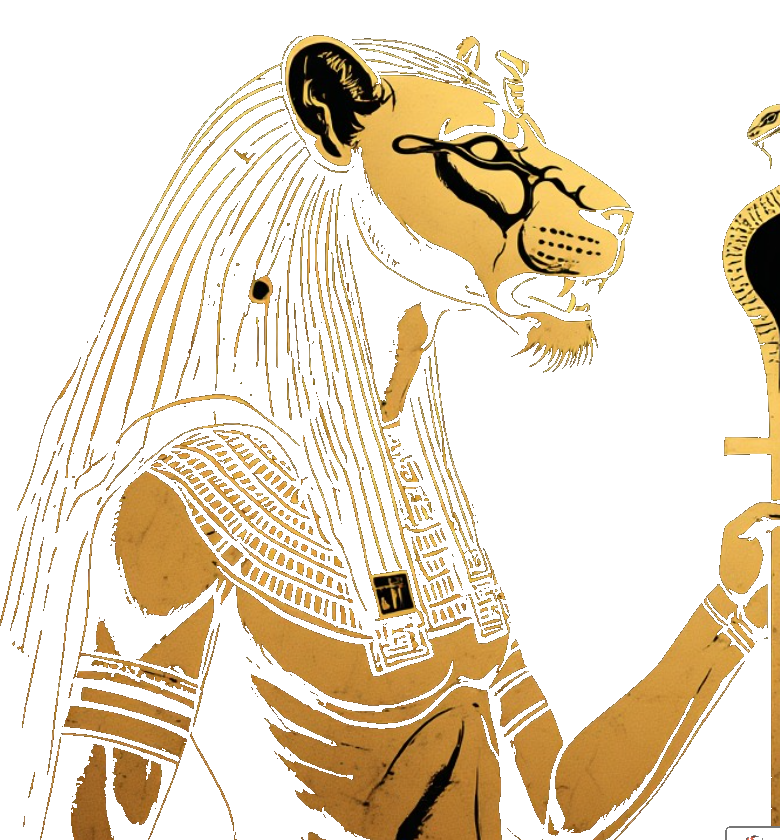
Lioness of the burning eye, whose breath is the desert wind.She is plague and remedy, the fever and its breaking.
Domains

Role
Sekhmet is the lion-headed goddess of war, pestilence, destruction, and healing, one of the most feared and revered deities in the Egyptian pantheon. Her name means "She Who Is Powerful," and she embodies the devastating, scorching aspect of the sun — the force that can bring plague, drought, and death. She is the daughter of Ra and the most terrifying manifestation of the "Eye of Ra," the solar deity's weapon of divine wrath. Yet Sekhmet is also a goddess of healing: the same destructive power that brings disease can also cure it, and her priests were among the most respected physicians in Egypt. This paradox of destruction and healing, plague and cure, reflects the Egyptian understanding that the most dangerous forces, once mastered, become the most potent sources of protection.
Significance
Sekhmet's theological significance lies in her embodiment of controlled divine violence. She represents the necessary destructive force without which cosmic order cannot be maintained, the burning heat that purifies and the war rage that defends. Her priests, the "wab" priests of Sekhmet, functioned as both religious officiants and medical practitioners, combining magical incantations with practical treatments in a holistic approach to healing that made no distinction between supernatural and natural causation. The "Ebers Papyrus" and other medical texts frequently invoke Sekhmet in connection with epidemic disease, and the annual "Pacification of Sekhmet" rituals were performed on the five epagomenal days to prevent the goddess from unleashing plague during the dangerous transition between years. Amenhotep III commissioned hundreds of monumental black granite statues of Sekhmet for the temple of Mut at Karnak, many of which survive in museums worldwide.
Cult & Worship
Sekhmet was particularly venerated at Memphis, where she formed a triad with Ptah (her consort) and Nefertem (their son). Her cult was closely intertwined with that of the goddess Mut at Thebes, where the two lion goddesses were sometimes treated as identical. The sheer number of Sekhmet statues commissioned by Amenhotep III — possibly 730, two for each day of the year — suggests a massive prophylactic ritual program, perhaps undertaken in response to a plague that struck Egypt during his reign. These statues, many standing over two meters tall, depict Sekhmet enthroned and crowned with the solar disk and uraeus, her expression serene despite her fearsome reputation. The annual "Festival of Intoxication" commemorated the pacification of Sekhmet-as-Hathor through beer, and ritual drunkenness was practiced as a reenactment of this mythological event, transforming a moment of cosmic crisis into communal celebration.
Mythological Narratives
Sekhmet's central myth is the "Destruction of Mankind," in which Ra dispatches his Eye in the form of Hathor-Sekhmet to punish rebellious humanity. The goddess rampages across Egypt, slaughtering humans and wading through their blood with such ecstatic violence that Ra himself grows alarmed and decides to save the remnant of humanity. Unable to recall the raging goddess by command, Ra orders seven thousand jars of beer mixed with red ochre and pomegranate juice to be poured upon the ground. Mistaking the mixture for blood, Sekhmet drinks until she is thoroughly intoxicated, falls asleep, and awakens as the gentle Hathor, her bloodlust forgotten. This narrative served as the mythological charter for annual pacification rituals and illustrated the fundamental Egyptian principle that even the most dangerous divine forces could be channeled and controlled through proper ritual knowledge.
Symbols & Attributes
Connections
Sources & References
- The Complete Gods and Goddesses of Ancient Egypt (2003)
- The Routledge Dictionary of Egyptian Gods and Goddesses (2005)