Deity
Ptah
greek Hephaestus
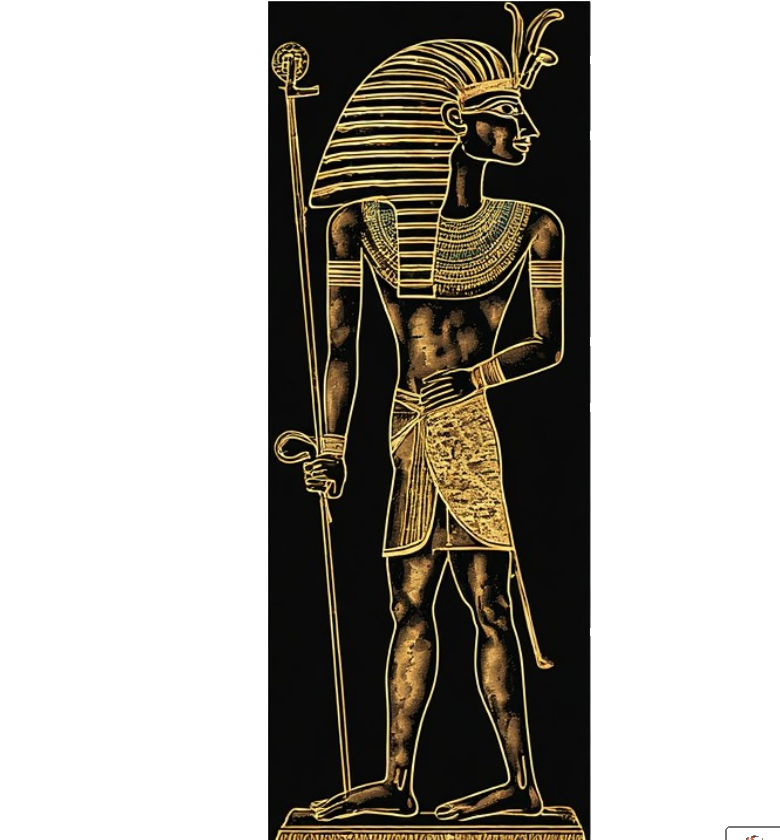
He who spoke the world into shape upon the potter's wheel of thought.Swathed in white, still as stone, yet all creation moves at his word.
Domains

Role
Ptah is the creator god of Memphis, the patron of craftsmen, architects, and artists, and one of the most intellectually sophisticated deities in the Egyptian theological system. Unlike Ra, who creates through physical emanation, or Atum, who creates through bodily fluids, Ptah creates through the power of thought (conceived in the heart) and speech (uttered by the tongue). This doctrine, preserved in the "Memphite Theology" inscribed on the Shabaka Stone (now in the British Museum), represents one of the earliest known articulations of creation through divine logos — the word as creative force. Ptah is typically depicted as a mummiform figure standing on a plinth, holding a composite scepter that combines the was, djed, and ankh symbols, representing power, stability, and life.
Significance
The Memphite Theology's account of creation through thought and speech places Ptah at the intersection of theology and philosophy, making him the Egyptian deity most comparable to the Greek concept of logos and the biblical "Word" of creation. As patron of craftsmen, Ptah sanctified all creative work as participation in the divine act of making. Every sculptor, architect, jeweler, and builder worked under his patronage, and the high priest of Ptah bore the title "Greatest of Directors of Craftsmanship." Ptah was closely associated with the Apis bull, the most important sacred animal in Egypt, and upon death each Apis bull was believed to merge with Osiris to form the composite deity Osiris-Apis (later Hellenized as Serapis). The theological link between the intellectual creator god and the vital, physical bull captures the Egyptian understanding that thought and matter are two expressions of the same creative force.
Cult & Worship
Ptah's great temple, the Hut-ka-Ptah ("Enclosure of the Ka of Ptah"), was the principal sanctuary of Memphis, Egypt's administrative capital for much of its history. The name of this temple, transliterated into Greek as "Aigyptos," is the etymological origin of the English word "Egypt" — making Ptah the god who gave the entire country its name. Although Memphis has been extensively quarried and little of the temple survives above ground, ancient descriptions and archaeological evidence indicate that it was one of the largest and most lavishly endowed temple complexes in the entire Nile Valley. The nearby Serapeum at Saqqara, the burial site of the sacred Apis bulls, was a major pilgrimage destination, and the catacombs containing massive granite sarcophagi of the bulls, discovered by Auguste Mariette in 1851, remain one of the most impressive archaeological sites in Egypt.
Mythological Narratives
The Shabaka Stone, though partially damaged by its later reuse as a millstone, preserves the Memphite cosmogony in which Ptah creates all things through the faculties of "heart" (thought, Egyptian "ib") and "tongue" (creative speech, Egyptian "ns"). In this system, Ptah first conceives each element of creation in his heart, then brings it into existence by pronouncing its name. This process encompasses not only physical things but also abstract concepts like justice and truth, making Ptah the creator of both the material and moral order. The text explicitly states that Ptah is "he who made all and created the gods," positioning Memphis and its theology as prior to and superior to the cosmogonies of Heliopolis and Hermopolis. Some scholars, including James Henry Breasted, have described this as the earliest known work of philosophy, anticipating Greek metaphysics by more than a millennium.
Legacy
Ptah's influence extended far beyond Memphis and beyond Egypt itself. His association with Sokar, the funerary god of the Memphite necropolis, and with Osiris produced the syncretic deity Ptah-Sokar-Osiris, one of the most commonly invoked gods in Late Period funerary practice. Wooden statuettes of Ptah-Sokar-Osiris, often containing rolled papyrus copies of Book of the Dead spells, were standard equipment in burials from the Late Period through the Ptolemaic era. The Greeks identified Ptah with Hephaestus, their own god of craftsmen and the forge, and Memphis was known to Greek writers as the city of Hephaestus. The Memphite Theology's concept of creation through speech represents one of ancient Egypt's most profound intellectual contributions, a theological insight whose echoes resound in the opening verse of the Gospel of John.
Symbols & Attributes
Connections
Sources & References
- The Complete Gods and Goddesses of Ancient Egypt (2003)
- Religion in Ancient Egypt (1991)
- Ancient Egypt: Anatomy of a Civilization (2006)