Deity
Hathor
greek Aphroditeegyptian Hwt-Hr
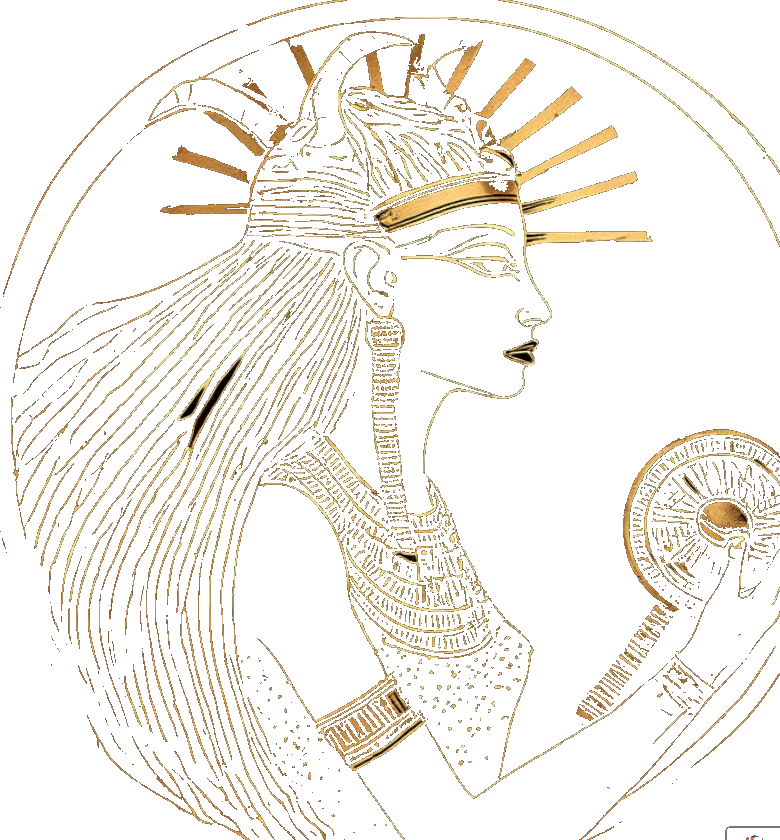
Golden lady of the sycamore, whose music stirs the heart of the world.She is joy and terror both — the dancing flame that warms and consumes.


Role
Hathor is the goddess of love, beauty, music, dance, joy, motherhood, and the sky, and one of the most ancient and widely venerated deities in Egypt. Her name, "Hwt-Hr," literally means "House of Horus," reflecting her role as the cosmic mother who encompasses the sky — the space within which the falcon god Horus flies. She is most commonly depicted as a woman wearing a headdress of cow horns enclosing a solar disk, or as a cow, and her bovine associations connect her to nurturing, fertility, and the life-giving properties of milk. Hathor also possesses a fearsome aspect as the "Eye of Ra," the solar deity's instrument of divine punishment. In this wrathful form she is essentially identical to Sekhmet, and the transformation between the gentle Hathor and the raging Sekhmet is a central theme in Egyptian solar mythology.
Significance
Hathor's theological significance spans an extraordinary range of human experience, from ecstatic celebration to the journey through death. She is the patroness of music, and the sistrum — a percussion instrument sacred to her worship — was one of the most iconic ritual objects in Egyptian religion. She presides over love, sexuality, and fertility, and was invoked in love poetry and marriage celebrations. Yet she is also the "Lady of the West," the goddess who receives the dead at the boundary of the afterlife, offering them food and drink from her sycamore tree as they enter the realm of the blessed. This dual nature — life-giving and death-welcoming — reflects the Egyptian understanding that the same divine maternal force that nurtures existence also provides comfort at its end.
Cult & Worship
Hathor's most magnificent temple stands at Dendera in Upper Egypt, one of the best-preserved temple complexes in the country. The current structure, dating primarily to the Ptolemaic and Roman periods, features stunning astronomical ceilings, crypts decorated with images of the goddess, and the famous "Dendera Zodiac" relief now housed in the Louvre. The annual "Festival of the Beautiful Meeting" sent Hathor's cult statue by sacred barge from Dendera south to Edfu for a ritual marriage with Horus, a festival of drinking, dancing, and celebration that lasted several weeks and attracted pilgrims from across Egypt. Hathor was also the primary deity of foreign mining regions, particularly Serabit el-Khadim in the Sinai peninsula, where turquoise miners maintained a rock-cut temple in her honor. Her epithet "Lady of Byblos" reflects her worship in the Levantine port city, and her cult was among the earliest Egyptian religious exports to the broader Near East.
Mythological Narratives
The myth of the "Destruction of Mankind," preserved in the Book of the Heavenly Cow from the tomb of Seti I, describes how Ra sends his Eye in the form of Hathor to punish rebellious humanity. Hathor-as-Sekhmet wades through human blood across Egypt, reveling in slaughter, until Ra relents and orders seven thousand jars of beer dyed red with ochre to be poured across the land. The goddess drinks the red beer, becomes intoxicated, and forgets her rage, transforming back into the benevolent Hathor. This myth was commemorated in the "Festival of Drunkenness," celebrated at Dendera and elsewhere, during which ritual intoxication was practiced as a religious act honoring the pacification of the dangerous goddess. In the myth of the "Distant Goddess," the Eye of Ra — identified variously as Tefnut or Hathor in different versions — flees to Nubia in a rage and must be coaxed back to Egypt by Thoth and Shu through music, dance, and flattery, a narrative that explains the annual inundation of the Nile and the return of fertility to the land.
Symbols & Attributes
Sources & References
- The Complete Gods and Goddesses of Ancient Egypt (2003)
- Egyptian Mythology: A Guide to the Gods, Goddesses, and Traditions (2004)