Deity
Thoth
greek Hermescoptic Thoutegyptian Djehuty
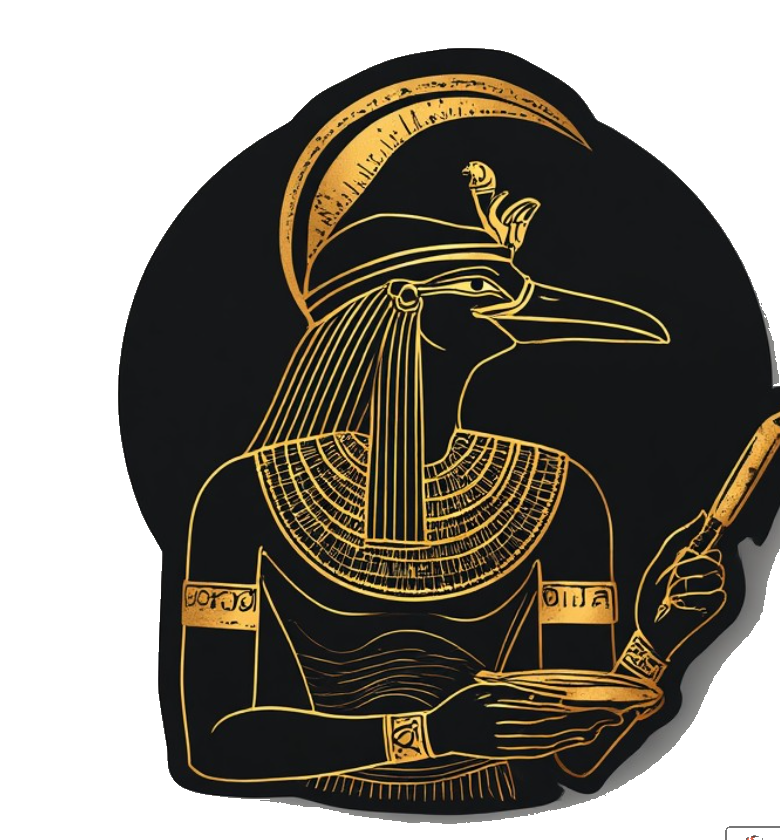
Ibis-headed scribe of the gods, measurer of time and keeper of all knowledge.His reed pen inscribes the verdicts of eternity.
Domains
Role
Thoth is the ibis-headed god of wisdom, writing, knowledge, science, magic, and the moon, serving as the divine scribe, mediator, and intellectual of the Egyptian pantheon. He is credited with the invention of hieroglyphs (called "medu netjer," the words of the god), mathematics, astronomy, and the calendar. In Egyptian theology, Thoth acts as the tongue and heart of Ra — the faculty of divine speech and reason that translates creative will into manifested reality. He records the verdicts in the judgment of the dead, maintains the cosmic balance, and serves as the mediator in divine disputes, most notably in the Contendings of Horus and Set. His association with the moon complements Ra's solar nature, making Thoth the lord of night, keeper of lunar time, and illuminator of darkness.
Significance
Thoth's theological importance rests on the Egyptian conviction that the universe is fundamentally knowable and that knowledge itself is a divine force. As the inventor of writing, Thoth is the source of all recorded knowledge, and every scribe was understood to be performing a sacred act under his patronage. The scribal profession was one of the most prestigious in Egyptian society, and the "Satire of the Trades" describes all other occupations as inferior to the scribe's calling. Thoth's magical texts were legendary: the "Book of Thoth" was said to contain all the secrets of the universe, and the pursuit of this forbidden knowledge forms the plot of the Demotic tale of Setne Khamwas. In the judgment scene of the Book of the Dead, Thoth records the results of the heart-weighing ceremony, his notation serving as the official divine record that determines the soul's eternal fate.
Cult & Worship
Thoth's principal cult center was Khmunu (Hermopolis Magna, modern el-Ashmunein) in Middle Egypt, where he was worshipped as the head of the Ogdoad, the eight primordial gods of the Hermopolitan creation tradition. Vast catacombs at nearby Tuna el-Gebel housed millions of mummified ibises and baboons — Thoth's sacred animals — deposited as votive offerings by pilgrims over centuries, representing one of the largest accumulations of animal mummies anywhere in Egypt. Archaeological excavations at Tuna el-Gebel have revealed that this sacred animal industry was a major economic enterprise, with breeding facilities, embalming workshops, and a complex bureaucratic infrastructure managing the production and sale of votive mummies. Under his Greek identification as Hermes, Thoth became the central figure of the Hermetic tradition, a body of philosophical, magical, and alchemical texts that profoundly influenced Western esoteric thought from late antiquity through the Renaissance.
Mythological Narratives
Thoth appears in numerous mythological narratives as the indispensable problem-solver of the divine world. In the "Contendings of Horus and Set," he serves as the secretary of the divine tribunal and frequently intervenes to resolve crises with his wisdom. When Horus's eye is torn out by Set, it is Thoth who heals and restores it, creating the "wedjat" or "whole eye" that became one of Egypt's most powerful protective symbols. In the "Destruction of Mankind," Thoth assists Ra in saving humanity by devising the plan to dye beer red to trick the raging Sekhmet. The "Calendar of Lucky and Unlucky Days" attributes to Thoth the gambling victory over the moon that won the five epagomenal days, extra days outside the regular 360-day year upon which Nut could give birth to her five children. The Hermetic texts, though composed in the Greco-Roman period, preserve the Egyptian conception of Thoth as the revealer of all sacred knowledge, the bridge between divine wisdom and human understanding.
Symbols & Attributes
Connections
Featured in
The Contendings of Horus and Set
The eighty-year legal and physical battle between Horus and Set before the divine tribunal for the throne of Egypt.
cosmic-battlekingshipjustice
Ra's Journey Through the Duat
Each night the sun god Ra travels through the twelve hours of the underworld, battling the chaos serpent Apophis before being reborn at dawn.
solar-cycledeathrebirthchaos
Sources & References
- The Complete Gods and Goddesses of Ancient Egypt (2003)
- Conceptions of God in Ancient Egypt (1982)
- Ancient Egyptian Religion (2002)