Primordial
Atum
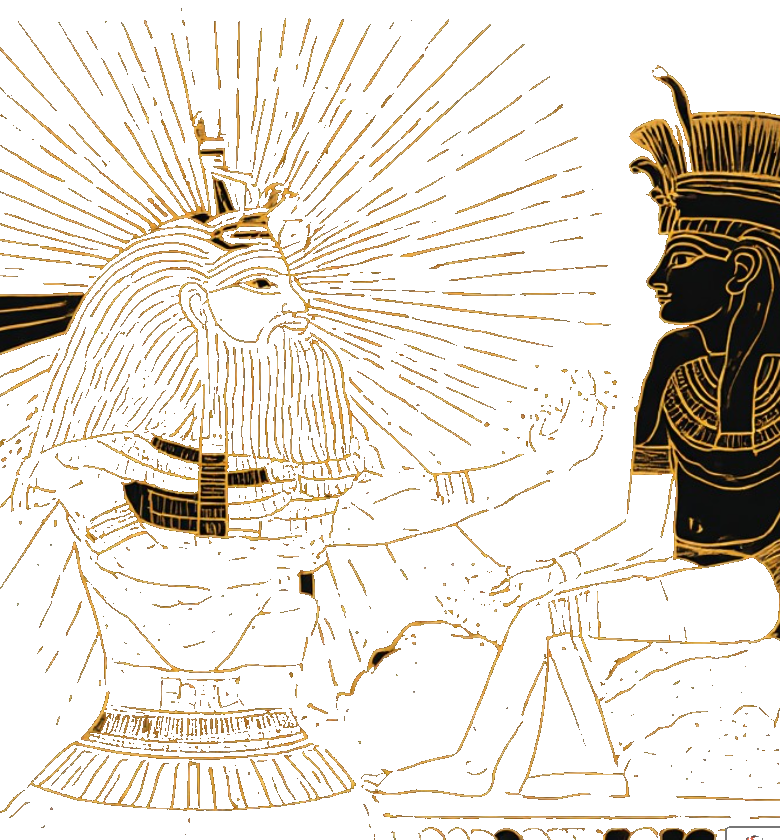
He who completed himself before anything was complete.The first spark in the endless dark, source and summit of all becoming.
Domains

Definition
Atum is the self-created first god of the Heliopolitan cosmogony, the deity who emerged from the primordial waters of Nun to begin the process of creation. His name derives from the Egyptian root "tm," meaning "to complete" or "to finish," reflecting his nature as the totality of existence contained within a single divine being. Atum created the first divine pair, Shu (air) and Tefnut (moisture), either by sneezing and spitting or through masturbation, acts that produced differentiation from his original unity.
Significance
Atum represents the theological concept of the "monad," the undifferentiated unity from which all multiplicity emerges. He is both the beginning and the end of creation: the Coffin Texts contain a famous passage in which Atum declares that at the end of time, he will dissolve the created world back into the primordial waters and return to his original serpent form, existing alone in the waters of Nun as he did before creation began. This cyclical vision of cosmic time, in which the universe emerges from and returns to primordial unity, is one of the most philosophically sophisticated concepts in Egyptian theology.
Mythological Context
In the Heliopolitan Ennead, Atum stands at the apex of the divine genealogy: from Atum come Shu and Tefnut, from them Geb and Nut, and from Geb and Nut the Osirian deities. Atum was closely associated with the evening sun, complementing Ra's association with the midday sun and Khepri's with the morning sun, creating a tripartite solar theology that mapped the sun's daily journey onto the stages of divine life. The "benben stone" at Heliopolis, upon which Atum first stood when he emerged from Nun, was the most sacred object in solar theology and the prototype for the pyramidion that crowned every pyramid and obelisk in Egypt.
Symbols & Attributes
Connections
Associated with Geb Atum is the grandfather of Geb through the intermediary generation of Shu and Tefnut
Associated with Nut Atum is the grandfather of Nut through the intermediary generation of Shu and Tefnut
Associated with Ra Ra and Atum merged as Ra-Atum, the evening and morning sun
Associated with Heliopolis Atum rose from the primordial mound at Heliopolis
Associated with Bennu The Bennu perched on the primordial mound at the dawn of creation
Associated with Nun Atum emerged from the waters of Nun at the first dawn
Sources & References
- Conceptions of God in Ancient Egypt (1982)
- The Complete Gods and Goddesses of Ancient Egypt (2003)