Deity
Nut
greek Rheacoptic Noutegyptian Nwt
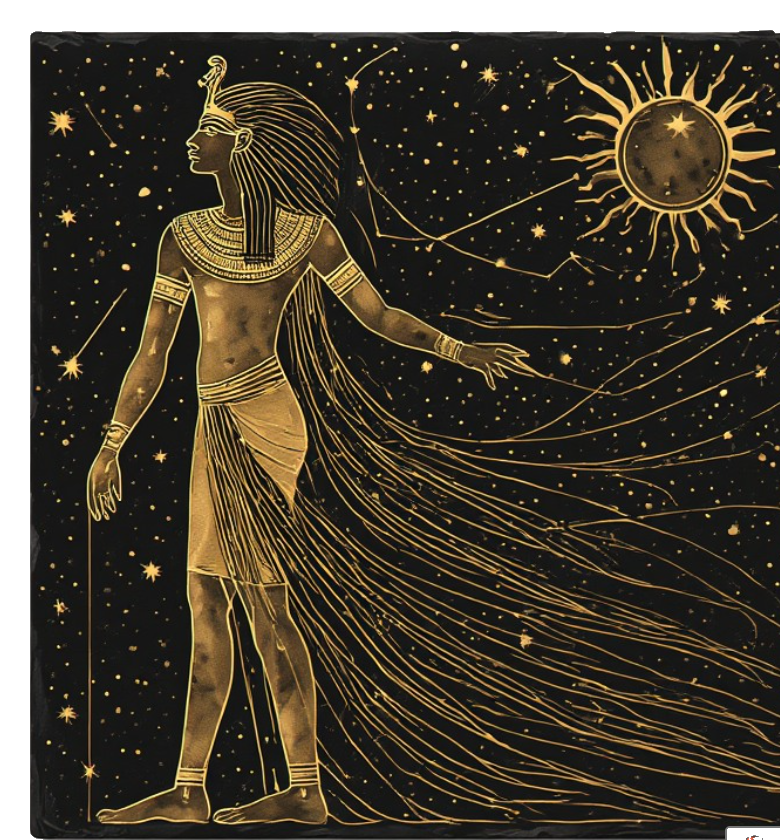
Star-swallowing vault of heaven, arched above the sleeping earth.She births the sun each dawn and devours it each dusk.
Domains
Role
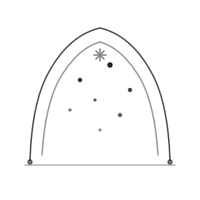
Nut is the sky goddess, one of the most visually distinctive deities in the Egyptian pantheon, typically depicted as a woman arching over the earth with her body spanning the entire sky, her fingers and toes touching the horizons. She is the daughter of Shu (air) and Tefnut (moisture), the sister-wife of Geb (earth), and the mother of Osiris, Isis, Set, Nephthys, and in some traditions Horus the Elder. In Egyptian cosmology, Nut's body is literally the sky: the stars are decorations on her belly, the sun travels along her body during the day, and at sunset Ra enters her mouth, journeys through her body during the night, and is reborn from her at dawn. Her father Shu stands between Nut and Geb, holding them apart to create the space in which life exists — a cosmological image that is one of the most iconic in Egyptian art.
Significance
Nut's theological significance encompasses both cosmic structure and the cycle of death and rebirth. Her body defines the upper boundary of the habitable world, containing the waters of the heavens that fall as rain and separating the ordered cosmos from the chaos beyond. Her daily swallowing and rebirthing of the sun provided the mythological explanation for the solar cycle and served as the fundamental metaphor for resurrection: the coffin of the deceased was identified with Nut's body, and images of the goddess were painted on the inner lids of sarcophagi so that the dead lay within her embrace, awaiting rebirth just as the sun is reborn each morning. The Pyramid Texts repeatedly identify the deceased king with the stars on Nut's body, promising an eternal celestial existence within the goddess herself.
Cult & Worship
Nut did not possess a major independent cult center, as her worship was primarily expressed through funerary practice and cosmological theology rather than through dedicated temple worship. Her most extensive surviving representations appear in royal tombs, particularly the cenotaph of Seti I at Abydos and several tombs in the Valley of the Kings, where monumental images of the goddess stretch across vaulted ceilings, her star-spangled body serving as the celestial canopy over the deceased pharaoh. The "Book of Nut," a cosmological text accompanied by detailed astronomical diagrams, describes the goddess's body as the framework of the Egyptian universe, mapping the movements of stars, planets, and the sun across her celestial form. The Pyramid Texts contain numerous invocations to Nut as the protective mother of the dead king, asking her to enfold him in her arms and number him among the imperishable stars.
Mythological Narratives
The most famous myth involving Nut concerns the curse of Ra: when Ra discovers that Nut is pregnant by Geb, he decrees that she shall not give birth on any day of the year. Thoth circumvents this prohibition by gambling with the moon and winning five extra days (the epagomenal days) that exist outside the regular calendar, allowing Nut to bear one child on each day: Osiris, Horus the Elder, Set, Isis, and Nephthys. This myth explains the Egyptian calendar's structure of 360 regular days plus five intercalary days and establishes the birth order of the major Osirian deities. In funerary literature, Nut is addressed as a maternal protector who gathers the dead into her embrace, and the "Nut texts" found on sarcophagi and tomb ceilings invoke her protection through elaborate astronomical and theological symbolism that transforms the burial chamber into a microcosm of the sky.
Symbols & Attributes
Connections
Sources & References
- The Complete Gods and Goddesses of Ancient Egypt (2003)
- Conceptions of God in Ancient Egypt (1982)