Deity
Isis
coptic Eseegyptian Aset
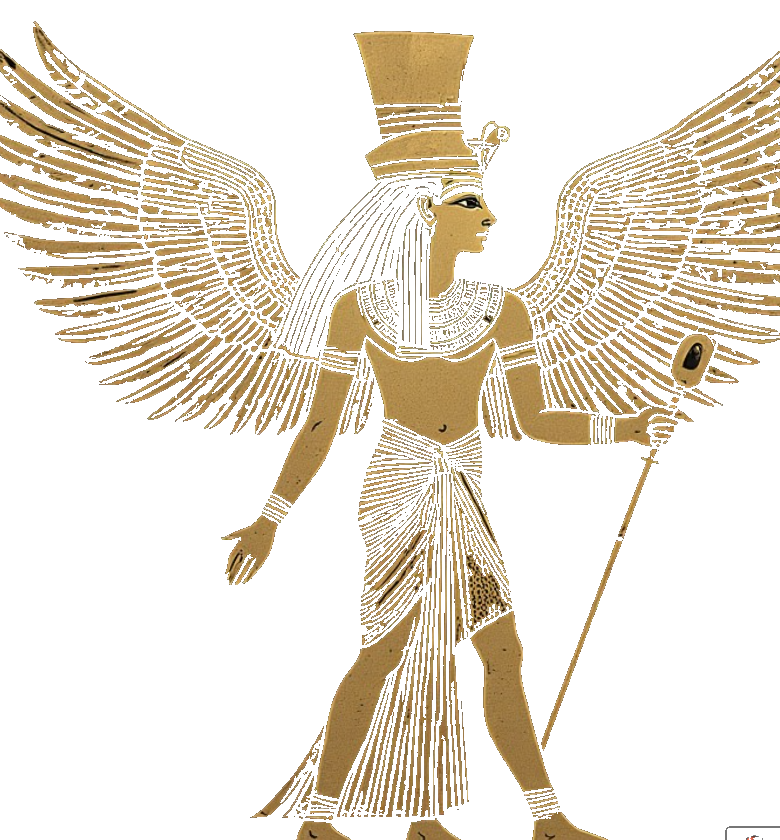
Great of magic, throne of kings, she who reassembled the broken world.Her wings shelter the living and the dead alike.
Domains

Role
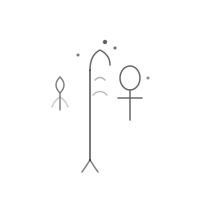
Isis is the goddess of magic, healing, motherhood, and wisdom, and arguably the most universally worshipped deity to emerge from Egyptian religion. Her name in Egyptian, Aset, means "throne," and she is often depicted with a throne hieroglyph upon her head, symbolizing her role as the literal seat of royal power — the king sits upon Isis as he sits upon his throne. She is the daughter of Geb and Nut, sister and wife of Osiris, and mother of Horus. Her magical abilities are described as surpassing those of all other gods: in the myth of "Isis and the Secret Name of Ra," she poisons the aging sun god with a serpent fashioned from his own spittle and earth, then refuses to heal him until he reveals his secret name, thereby obtaining supreme magical power.
Significance
Isis embodies the Egyptian ideal of devoted wifehood and fierce motherhood, but she is far more than a domestic goddess. She is the "Great of Magic" (weret hekau), whose spells can alter the course of fate, resurrect the dead, and heal any wound or poison. Her role in the Osiris myth establishes her as the architect of resurrection itself: it is Isis who searches for and reassembles the dismembered body of Osiris, who fashions the missing phallus from gold, who transforms into a kite and hovers over the body to conceive Horus, and who raises her son in the marshes of the Delta in hiding from Set. Every one of these acts became a mythological precedent for ritual action, with healers, mourners, and mothers all invoking Isis as the divine model for their own struggles.
Cult & Worship
While Isis was worshipped throughout Egypt, her most famous temple was the magnificent complex on the island of Philae near Aswan, which became one of the last functioning centers of traditional Egyptian religion, remaining active until the sixth century CE when it was finally closed by the Emperor Justinian. The temple at Philae, now relocated to the nearby island of Agilkia due to the construction of the Aswan High Dam, preserves some of the finest Ptolemaic and Roman period relief carving in Egypt. The Isis cult spread far beyond Egypt's borders during the Hellenistic and Roman periods, becoming one of the great "mystery religions" of the ancient Mediterranean world, with temples (Iseia) established in Rome, Pompeii, Athens, London, and throughout the Roman Empire. Apuleius's "Metamorphoses" (second century CE) contains a vivid account of initiation into the Isis mysteries, and the iconography of Isis nursing the infant Horus has been frequently discussed as a possible influence on early Christian imagery of the Madonna and Child.
Mythological Narratives
Beyond the Osiris cycle, Isis features in numerous mythological narratives that showcase her magical prowess and maternal devotion. The "Metternich Stela" and related magical texts describe how the infant Horus was stung by a scorpion while Isis hid with him in the Delta marshes, and how Isis commanded the very cosmos to halt until Thoth descended from the solar bark to heal her son. These narratives served as the basis for healing spells used by Egyptian physicians for millennia. In the "Contendings of Horus and Set," Isis acts as the cunning advocate for her son's claim to the throne, repeatedly outwitting Set through disguise, deception, and superior magical knowledge. Her intelligence and resourcefulness in these texts are described in terms that make her not merely the mother of the king but the true power behind the throne, the goddess whose wisdom ensures that justice ultimately prevails.
Legacy
The cult of Isis represents perhaps the most successful religious export in ancient history. From her origins as a member of the Heliopolitan Ennead, she grew to become a universal goddess worshipped from Britain to Afghanistan. The aretalogies (self-praise hymns) of Isis from the Greco-Roman period describe her as the inventor of writing, the establisher of justice, the ruler of fate, and the queen of all gods — a scope of power that effectively made her a monotheistic supreme deity for her devotees. Her worship persisted for centuries after the fall of pharaonic Egypt, and scholars have traced elements of her cult into medieval European religious practice and iconography. The temple at Philae, the last bastion of ancient Egyptian religion, was dedicated to Isis, a fitting testament to her enduring power.
Symbols & Attributes
Connections
Featured in
The Osiris Myth
The murder of Osiris by his brother Set, his resurrection by Isis, and the birth of Horus who would avenge his father and claim the throne.
deathresurrectionkingshipbetrayal
The Contendings of Horus and Set
The eighty-year legal and physical battle between Horus and Set before the divine tribunal for the throne of Egypt.
cosmic-battlekingshipjustice
Isis and the Seven Scorpions
Isis, fleeing with the infant Horus, is aided by seven scorpions who punish a woman who refused her shelter and heal a child stung in retaliation.
magicjusticeprotection
Sources & References
- The Complete Gods and Goddesses of Ancient Egypt (2003)
- Egyptian Mythology: A Guide to the Gods, Goddesses, and Traditions (2004)
- The Routledge Dictionary of Egyptian Gods and Goddesses (2005)