Deity
Horus
coptic Horegyptian Heru
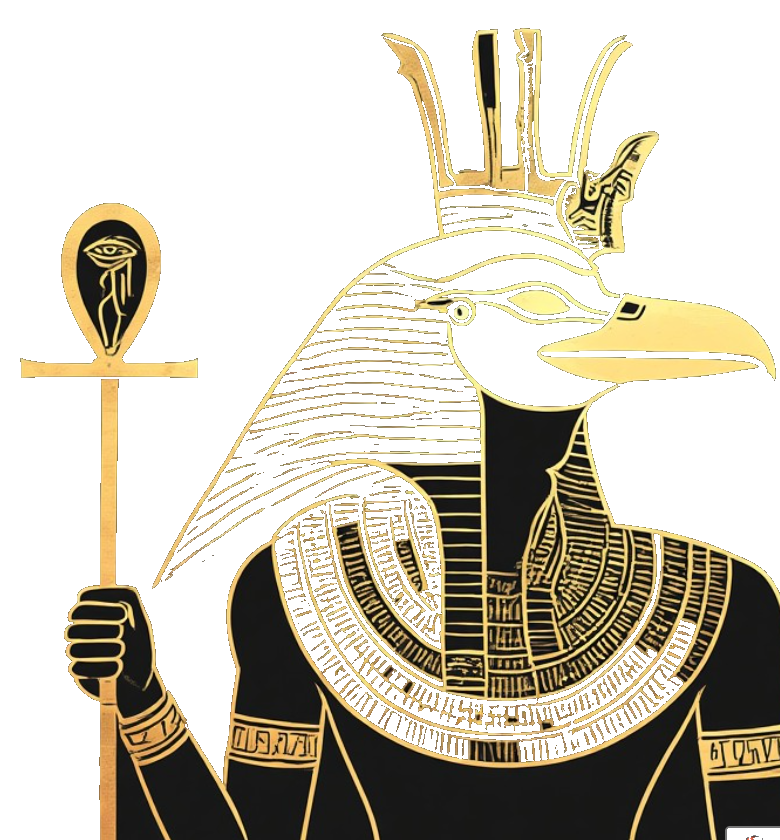
Falcon upon the horizon, avenger of his father, living throne of Egypt.His eye is the moon, his gaze the sun — all the sky belongs to him.
Domains
Role
Horus is the falcon-headed sky god, the divine embodiment of kingship, and one of the oldest and most complex deities in the Egyptian pantheon. The name "Horus" (Egyptian Heru, meaning "the distant one" or "the one on high") encompasses several distinct but theologically intertwined divine figures: Horus the Elder (Haroeris), a primeval sky god whose eyes were the sun and moon; Horus the Child (Harpocrates), the infant son of Isis raised in hiding from Set; and Horus of Behdet (Behdety), the winged sun disk. The living pharaoh was considered the earthly manifestation of Horus, and the "Horus name" was the oldest element of the royal titulary, appearing on inscriptions from the very beginning of the dynastic period around 3100 BCE.
Significance
Horus's theological significance is inseparable from the institution of Egyptian kingship. The fundamental political theology of Egypt rested on the identification of the living king with Horus and the dead king with Osiris, creating an eternal cycle of succession that mirrored the mythological narrative: just as Horus avenged his father Osiris and assumed the throne, so each new pharaoh performed funerary rites for his predecessor and inherited legitimate sovereignty. The "Eye of Horus" (wedjat) became one of the most powerful and ubiquitous symbols in Egyptian culture, representing healing, protection, and wholeness. According to myth, Horus lost his eye in combat with Set, and Thoth restored it; the restored eye thus symbolized the triumph of order over chaos and became a standard protective amulet found in burials throughout Egyptian history.
Cult & Worship
Horus was worshipped in various forms at numerous cult centers across Egypt. Nekhen (Hierakonpolis), the "City of the Falcon," was one of the earliest centers of Horus worship and a crucial site in the formation of the Egyptian state during the Predynastic period. The magnificent temple of Horus at Edfu (ancient Mesen), built during the Ptolemaic period between 237 and 57 BCE, is the best-preserved major temple in Egypt and provides an extraordinarily detailed record of temple ritual, mythology, and theology through its extensive wall reliefs and inscriptions. The annual "Festival of the Beautiful Meeting" saw the cult statue of Hathor travel by barge from her temple at Dendera to visit Horus at Edfu, a ritual marriage that celebrated the union of complementary divine forces. At Kom Ombo, Horus the Elder (Haroeris) shared a unique double temple with the crocodile god Sobek, reflecting the theological complexity of Egyptian polytheism.
Mythological Narratives
The "Contendings of Horus and Set," preserved most fully in Papyrus Chester Beatty I (Twentieth Dynasty), is a vivid and at times bawdy mythological narrative describing the eighty-year legal dispute between Horus and Set over the throne of Osiris. The gods of the Ennead serve as judges in this cosmic lawsuit, with Ra initially favoring Set due to his superior strength. The narrative includes episodes of physical combat, magical contests, and cunning trickery, with Isis repeatedly intervening on behalf of her son. The resolution comes when Osiris threatens from the underworld to send his "fierce-faced messengers" against the gods if they do not award the throne to Horus. This text reveals the Egyptian understanding of kingship as something that must be won through both physical prowess and legal legitimacy, and it demonstrates that even divine justice requires persistent advocacy.
Historical Context
Archaeological evidence for the worship of Horus extends to the very dawn of Egyptian civilization. Predynastic falcon imagery from Hierakonpolis and Naqada suggests that a falcon deity was already associated with chiefly power before the unification of Egypt. The Narmer Palette (ca. 3100 BCE) shows the falcon god Horus presenting the conquered inhabitants of the Delta to the king, establishing the theological framework that would persist for three millennia. Throughout Egyptian history, the Horus-Set conflict served as the mythological template for understanding cosmic and political tension: Upper vs. Lower Egypt, order vs. chaos, legitimate rule vs. usurpation. The Ptolemaic rulers, though Macedonian Greeks, adopted the full Horus titulary and invested heavily in Horus temples, recognizing that the falcon god's endorsement was essential to political legitimacy in Egypt.
Symbols & Attributes
Connections
Child of Osiris Father of Horus, conceived posthumously
Child of Isis Mother and fierce protector of Horus
Rival of Set Horus and Set battled for eighty years for the throne of Egypt
Associated with Thebes Horus was worshipped at Thebes alongside Amun, particularly in forms such as Horus of Edfu honored at Karnak
Featured in
The Osiris Myth
The murder of Osiris by his brother Set, his resurrection by Isis, and the birth of Horus who would avenge his father and claim the throne.
deathresurrectionkingshipbetrayal
The Contendings of Horus and Set
The eighty-year legal and physical battle between Horus and Set before the divine tribunal for the throne of Egypt.
cosmic-battlekingshipjustice
Isis and the Seven Scorpions
Isis, fleeing with the infant Horus, is aided by seven scorpions who punish a woman who refused her shelter and heal a child stung in retaliation.
magicjusticeprotection
Sources & References
- The Complete Gods and Goddesses of Ancient Egypt (2003)
- Conceptions of God in Ancient Egypt (1982)