Deity
Osiris
coptic Ousireegyptian Wsir
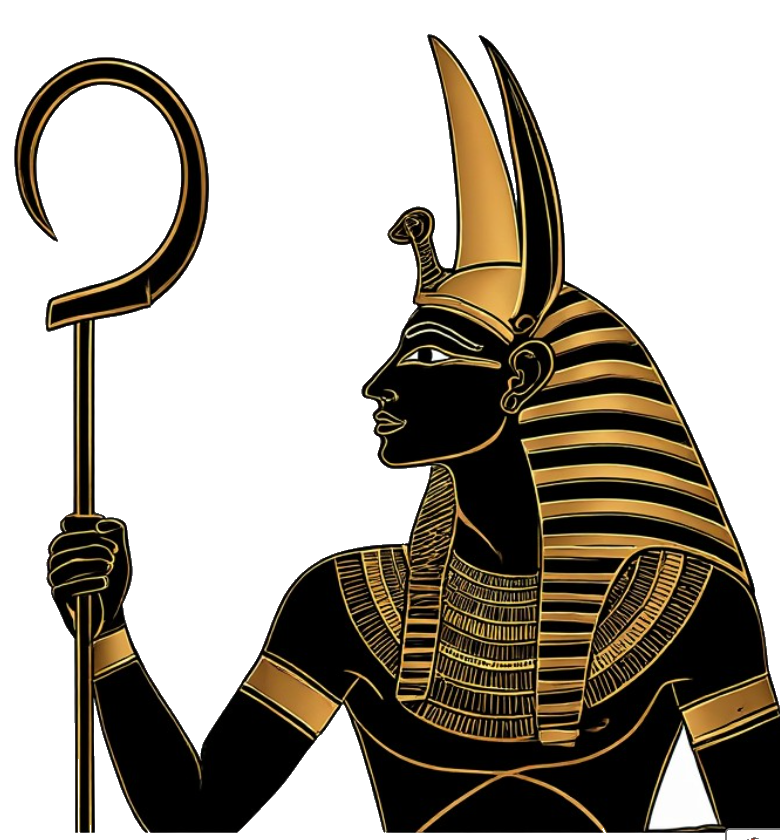
Green-skinned lord of the silent land, who died and rose again.He reigns where the living cannot follow, judge of every heart.
Role
Osiris is the god of the dead, the afterlife, and resurrection, and one of the most important and widely worshipped deities in the entire Egyptian pantheon. He is the eldest son of Geb and Nut, brother and husband of Isis, and father of Horus. In Egyptian theology, Osiris was originally a just and benevolent king of Egypt who brought civilization, agriculture, and law to humanity before being murdered by his jealous brother Set. His death and resurrection established the theological pattern for all Egyptian funerary belief: just as Osiris died and was restored to life through the magical interventions of Isis and Anubis, so too could every deceased Egyptian hope for eternal life through proper mummification, ritual, and moral conduct.
Significance
Osiris's theological significance lies in his unique dual role as both a dead god and a living king of the underworld. He is the prototype of the blessed dead, demonstrating that death is not annihilation but transformation. The "Osirian" model of the afterlife democratized Egyptian funerary religion over time: while the earliest Pyramid Texts reserved identification with Osiris for the pharaoh alone, by the Middle Kingdom the Coffin Texts extended this privilege to non-royal individuals, and by the New Kingdom the Book of the Dead made Osirian afterlife theology accessible to anyone who could afford the requisite rituals and papyrus scrolls. The concept of the "Osiris NN" (where NN is the name of the deceased) became standard funerary nomenclature, reflecting the belief that every justified dead person literally became Osiris.
Cult & Worship
Osiris's primary cult center was Abydos in Upper Egypt, where his tomb was believed to be located (actually the tomb of the First Dynasty king Djer). Abydos became the most important pilgrimage site in Egypt, and wealthy Egyptians erected cenotaphs and memorial stelae along the processional route to ensure their eternal participation in the mysteries of Osiris. The annual "Mysteries of Osiris" at Abydos, described in the stela of Ikhernofret (Twelfth Dynasty), involved elaborate dramatic performances reenacting the god's death, dismemberment, reassembly, and resurrection. Busiris in the Delta was another major cult center, where Osiris was worshipped in his aspect as the "Djed pillar," a fetish symbol representing stability and endurance. The Khoiak festival, celebrated throughout Egypt, involved the creation of "Osiris beds" — mummy-shaped containers filled with soil and grain that were watered and allowed to sprout, symbolizing resurrection through the cycle of vegetation.
Mythological Narratives
The myth of Osiris, though never preserved in a single continuous Egyptian narrative, is known from numerous allusions in the Pyramid Texts, Coffin Texts, and later compositions, as well as from the detailed Greek account by Plutarch in "De Iside et Osiride." Set murders Osiris through trickery — in Plutarch's version, by trapping him in a chest — and dismembers the body, scattering the pieces across Egypt. Isis, aided by her sister Nephthys, searches for and reassembles the body parts, and through her magical skill temporarily revives Osiris long enough to conceive their son Horus. Anubis then performs the first mummification, preserving Osiris's body for eternity. Osiris descends to rule the underworld as king and judge of the dead, presiding over the Weighing of the Heart ceremony in the Hall of Ma'at, where the hearts of the deceased are weighed against the feather of truth. This myth cycle provided the foundational narrative for Egyptian civilization's relationship with death and the afterlife.
Historical Context
The cult of Osiris grew steadily in importance throughout Egyptian history. In the Old Kingdom, Osiris was primarily associated with royal funerary rites, but by the First Intermediate Period his worship had expanded dramatically to encompass all social classes. The Coffin Texts of the Middle Kingdom reveal an increasingly elaborate Osirian underworld geography, with detailed maps and spells for navigating the afterlife. During the New Kingdom, the Book of the Dead codified Osirian funerary theology into a standardized collection of spells and vignettes, the most famous being Chapter 125, which depicts the judgment scene before Osiris. The Ptolemaic period saw the development of Serapis, a syncretic Greco-Egyptian deity combining Osiris with the Apis bull, demonstrating the continued vitality and adaptability of Osirian theology even under foreign rule.
Symbols & Attributes
Connections
Child of Geb Father of Osiris
Child of Nut Mother of Osiris
Consort of Isis King and queen of the gods; Isis resurrected Osiris after his murder
Parent of Horus Father of Horus, conceived posthumously
Slain by Set Set murdered Osiris by trapping him in a coffin and casting him into the Nile
Associated with Anubis Anubis embalmed Osiris, creating the first mummy
Associated with Duat Osiris rules the Duat as king of the dead
Associated with Field of Reeds The blessed dead dwell in the Field of Reeds under Osiris's rule
Associated with Abydos Abydos was the holiest site of Osiris's cult; his tomb was believed to lie there
Associated with Ka & Ba The ka and ba unite with Osiris in the afterlife
Sources & References
- The Complete Gods and Goddesses of Ancient Egypt (2003)
- The Egyptian Book of the Dead (1972)
- Ancient Egyptian Religion (2002)