Deity
Geb
greek Kronoscoptic Keb
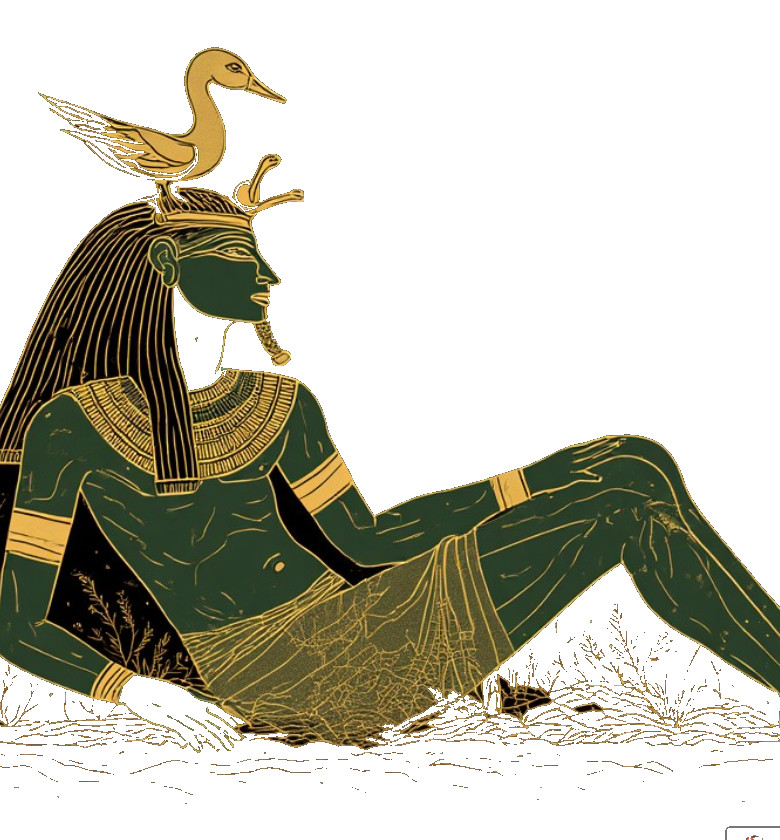
Recumbent lord of the fertile ground, whose laughter shakes the land.He is the body upon which all things grow, the foundation beneath all feet.
Domains
Role
Geb is the earth god of the Heliopolitan Ennead, the son of Shu and Tefnut, the brother-husband of Nut, and the father of Osiris, Isis, Set, and Nephthys. In Egyptian art, Geb is typically depicted as a man lying on his side beneath the arched body of Nut, sometimes with vegetation growing from his body, representing the earth's fertility. He is one of the few male earth deities in ancient mythology, most cultures assigning feminine qualities to the earth; this Egyptian inversion, pairing a male earth with a female sky, is a distinctive feature of Egyptian cosmological thought. Geb's skin is often shown as green or black, representing the fertile Nile soil, and earthquakes were attributed to his laughter or movements.
Significance
Geb holds profound significance as the divine ancestor of Egyptian kingship. The throne of Egypt was called the "Throne of Geb," and the pharaoh was described as Geb's heir. In the mythological succession, Geb inherits rulership from Shu and in turn passes it to Osiris, establishing the divine precedent for legitimate royal succession. The "Great Cackler" was one of Geb's epithets, referring to a cosmogonic tradition in which his laughter (or the cry of a cosmic goose) laid the egg from which the sun was hatched. Geb also played an important judicial role: in the Contendings of Horus and Set, it is Geb who presides over part of the divine tribunal and ultimately assigns the inheritance of Egypt to Horus, affirming the principle of primogeniture and legitimate succession.
Cult & Worship
Geb did not possess a major independent cult center, though he was venerated throughout Egypt as a member of the Heliopolitan Ennead. His worship was integrated into the broader solar and Osirian theological frameworks, and he appears frequently in the Pyramid Texts and Coffin Texts as a protective figure who provides the deceased with sustenance from the earth. The "House of Geb" is mentioned in several texts as a location in the afterlife where the justified dead receive offerings. In agricultural rituals, Geb was invoked to ensure the fertility of the soil and the success of the harvest, his recumbent body serving as the theological ground upon which all agricultural activity, and indeed all earthly life, depended.
Mythological Narratives
Geb's most significant mythological role is as the father of the Osirian deities and the arbiter of the divine succession. In the Ennead genealogy, Geb and Nut's passionate embrace is forcibly separated by their father Shu, who lifts Nut to form the sky while Geb remains below as the earth. This act of separation creates the habitable space between earth and sky, and Geb's enduring grief at his separation from Nut is expressed in his posture — lying prone, reaching upward toward the sky. In the Coffin Texts, Geb is described as trapping the dead within the earth, making him both a nurturing and a confining figure. The "Myth of Geb and the Divine Ennead" describes how Geb inherits the kingship from Shu after a period of cosmic conflict, establishing the precedent that kingship passes from father to son through proper succession rather than through force.
Symbols & Attributes
Connections
Sources & References
- The Complete Gods and Goddesses of Ancient Egypt (2003)
- Religion in Ancient Egypt (1991)
- Conceptions of God in Ancient Egypt (1982)