Concept
Duat
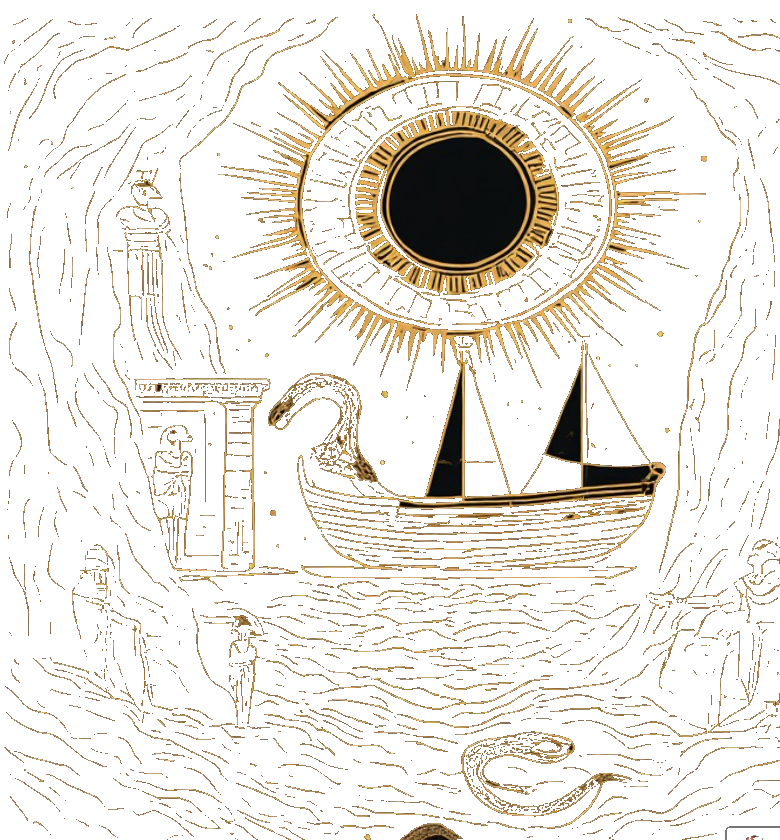
The hidden realm beneath the world, through which the sun must pass each night.A land of gates and trials, where the dead are weighed and the worthy reborn.
Domains
Definition
The Duat is the Egyptian underworld, a vast, complex, and dangerous realm through which the sun god Ra travels each night and through which the souls of the dead must navigate to reach the blessed afterlife. Unlike simple conceptions of an underworld as a single dark cavern, the Duat is an elaborately structured cosmos unto itself, divided into twelve hours or regions, each with its own geography, inhabitants, guardians, and dangers. The funerary books of the New Kingdom — the Amduat, the Book of Gates, the Book of Caverns — provide detailed maps and descriptions of the Duat's topography.
Significance
The Duat is not merely a place of the dead but the theater of cosmic renewal: each night, Ra's passage through its regions regenerates both the sun and the blessed dead, who awaken temporarily as Ra's light passes through their realm. The Duat contains lakes of fire, fields of offerings, serpent-guarded gates, and the deepest pit where Apophis lies in ambush. Successful navigation requires knowledge of the correct spells, passwords, and the names of the gatekeepers — information provided by the funerary texts placed in tombs. The concept of the Duat influenced later religious traditions, including elements of the Jewish concept of Sheol, the Christian concept of Purgatory, and Islamic descriptions of the afterlife journey.
Mythological Context
The Amduat ("That Which Is in the Underworld"), first attested in the tomb of Thutmose I, describes Ra's twelve-hour journey through the Duat in extraordinary detail, with each hour depicting the sun god's encounters with the denizens of the underworld, including the blessed dead, the damned, and a host of protective and dangerous supernatural beings. The seventh hour, the deepest point of the journey, marks Ra's confrontation with Apophis, and the twelfth hour culminates in Ra's rebirth as the morning sun, emerging from the eastern horizon to renew the cycle of creation. The royal tombs in the Valley of the Kings served as architectural models of the Duat, their descending corridors and chambers mirroring the underworld's structure and their wall decorations transforming the tomb into a three-dimensional map of the afterlife.
Symbols & Attributes
Connections
Sources & References
- The Egyptian Book of the Dead (1972)
- Conceptions of God in Ancient Egypt (1982)