Deity
Anubis
coptic Anoupegyptian Inpu
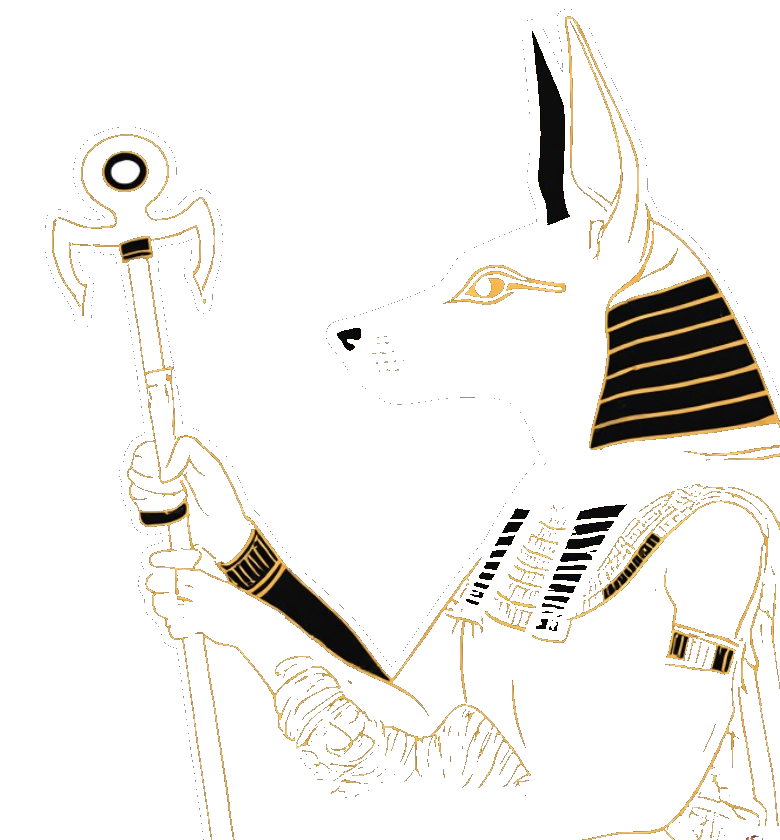
Black jackal at the threshold, guardian of the silent passage.His hands prepare the body; his judgment weighs the soul.
Domains
Role
Anubis is the jackal-headed god of mummification, embalming, funerary rites, and the guardian of the necropolis. Before the rise of Osiris to prominence in the Middle Kingdom, Anubis was the preeminent god of the dead in Egypt, a role reflected in the Pyramid Texts where he is frequently invoked as the chief protector of the deceased pharaoh. His parentage varies across sources: in some traditions he is the son of Ra, in others the son of Osiris and Nephthys, conceived in an illicit union that drove Nephthys to abandon the infant in the desert, where Isis found and raised him. His black coloring does not represent the jackal's natural fur but rather the color of mummified flesh and the rich black soil of the Nile Valley, both associated with resurrection and regeneration.
Significance
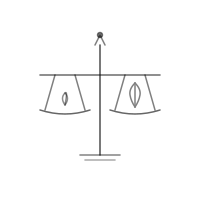
Anubis's theological significance centers on his role as the inventor and patron of mummification, the process by which the physical body was preserved for the afterlife. According to Egyptian mythology, Anubis performed the first embalming on the body of Osiris, establishing the ritual procedures that the embalmer priests (who wore jackal masks during their work) would follow for millennia. He also plays a crucial role in the judgment of the dead: in the vignettes of Book of the Dead Chapter 125, Anubis is depicted leading the deceased into the Hall of Ma'at and operating the scales upon which the heart is weighed against the feather of truth. This role as psychopomp — guide of the dead between worlds — made Anubis the deity most intimately connected to the individual Egyptian's passage from life to afterlife.
Cult & Worship
Anubis was worshipped throughout Egypt, but his principal cult center was at Hardai (Cynopolis, "Dog City") in Upper Egypt. His association with the cemetery and the desert edge meant that every necropolis was effectively his domain, and the title "He Who Is upon His Mountain" (Tepy-dju-ef) refers to the jackal god watching over the desert cliffs that typically flanked Egyptian burial grounds. Numerous wooden and stone Anubis statues have been recovered from tombs, often positioned atop shrine-shaped chests containing canopic equipment or other funerary materials. The famous recumbent Anubis figure from the tomb of Tutankhamun, gilded and draped in linen, is one of the most recognizable artifacts from ancient Egypt. Priests known as "stm" performed funerary rituals wearing jackal masks to embody Anubis during the embalming process and the Opening of the Mouth ceremony.
Mythological Narratives
In the Osiris myth cycle, Anubis plays an indispensable role: after Isis and Nephthys recover the dismembered body of Osiris, it is Anubis who wraps the body in linen bandages, applies sacred oils and resins, and performs the funerary rites that enable Osiris to be resurrected as ruler of the underworld. This mythological precedent established mummification as a sacred act of divine origin. The "Jumilhac Papyrus" preserves a rich collection of Anubis myths from the Ptolemaic period, including narratives in which Anubis defeats Set in combat and flays his skin to create a leopard-print garment, explaining the leopard skin worn by "sem" priests during funerary rituals. These texts portray Anubis as a fierce protector of the dead who actively combats the forces that would disturb or defile the burial, ensuring the eternal safety of those committed to his care.
Symbols & Attributes
Connections
Associated with Osiris Anubis embalmed Osiris, creating the first mummy
Associated with Duat Anubis guides souls through the underworld
Associated with Ammit Ammit crouches beside Anubis's scales during the judgment
Child of Nephthys Nephthys is the mother of Anubis in some traditions
Associated with Ka & Ba Anubis oversees the preservation of the ka through mummification
Sources & References
- The Complete Gods and Goddesses of Ancient Egypt (2003)
- The Egyptian Book of the Dead (1972)
- The Routledge Dictionary of Egyptian Gods and Goddesses (2005)