Deity
Sobek
greek Suchoscoptic Soukiegyptian Sbk
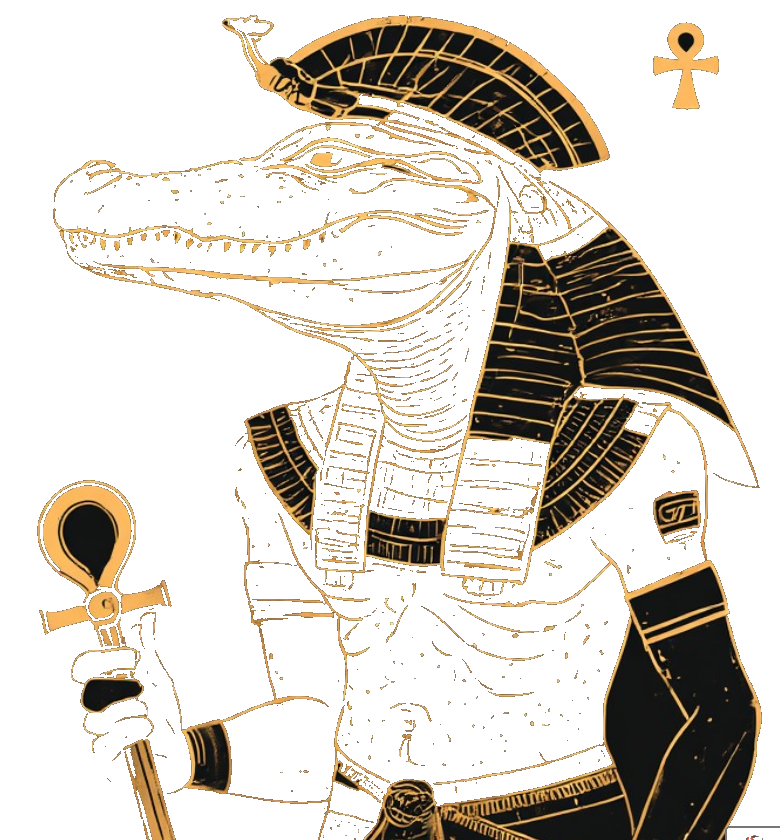
Jaws of the river, lord of the waters that give and take life.He basks in the sun-warmed shallows, ancient as the current itself.
Domains

Role
Sobek is the crocodile god associated with the Nile, military prowess, fertility, and pharaonic power. He embodies the primal, dangerous forces of the river that sustained all Egyptian life — the same waters that irrigated crops could also harbor the deadly Nile crocodile, and Sobek represents this dual nature of the life-giving river as both benefactor and destroyer. In Egyptian theology, Sobek was sometimes identified as a creator god who emerged from the primordial waters, and in certain traditions he was credited with creating the Nile from his own sweat. His aggressive, predatory nature made him a natural patron of military strength, and pharaohs from the Twelfth and Thirteenth Dynasties bore names honoring Sobek, reflecting the god's association with royal power during the Middle Kingdom.
Significance
Sobek's theological significance lies in his embodiment of the Nile's ambivalent power. The crocodile was simultaneously the most feared predator in the Egyptian environment and a symbol of sovereign strength and fertility. By worshipping Sobek, Egyptians sought to propitiate and channel the dangerous forces of the natural world rather than simply avoid them. Sobek was associated with the annual Nile inundation, the event that determined whether Egypt would enjoy abundance or famine, and his favor was considered essential for agricultural success. In some Faiyum traditions, Sobek was syncretized with Ra as Sobek-Ra, combining solar supremacy with aquatic power and elevating the crocodile god to cosmic significance.
Cult & Worship
Sobek was worshipped throughout Egypt but had two principal cult centers: Shedet (Crocodilopolis, modern Medinet el-Faiyum) in the Faiyum oasis, and the double temple at Kom Ombo in Upper Egypt, which he shared with Horus the Elder. At Shedet, sacred crocodiles were kept in temple pools, adorned with gold earrings and bracelets, hand-fed choice cuts of meat and honey cakes, and upon death were mummified and buried with full ceremonial honors. Strabo, who visited the temple in the first century BCE, left a vivid description of the feeding of the sacred crocodile "Petsuchos." Kom Ombo's unique double temple, with its symmetrical halves dedicated to Sobek and Haroeris, preserves extensive reliefs showing medical instruments, a calendar, and scenes of pharaohs making offerings to both gods, providing invaluable evidence of Ptolemaic religious practice.
Mythological Narratives
Sobek appears in several mythological contexts that emphasize his role as a powerful but ambiguous divine force. In some versions of the Osiris myth, Sobek assists Isis in recovering the body of Osiris from the Nile, using his aquatic mastery to retrieve the dismembered parts. In other traditions, however, Sobek is associated with Set and the forces of chaos, reflecting the genuine terror that crocodiles inspired in the Egyptian population. The "Book of the Faiyum," a Ptolemaic-era geographical and theological text, presents Sobek as the central deity of the Faiyum region, describing his control over the waters, his solar associations, and the elaborate rituals performed at his temple. The Coffin Texts include spells in which the deceased identifies with Sobek, claiming his power and ferocity as protection in the afterlife, demonstrating the god's importance in funerary contexts as well as in the living world.
Symbols & Attributes
Connections
Sources & References
- The Complete Gods and Goddesses of Ancient Egypt (2003)
- Egyptian Mythology: A Guide to the Gods, Goddesses, and Traditions (2004)