Hero
Khufu
greek Cheops
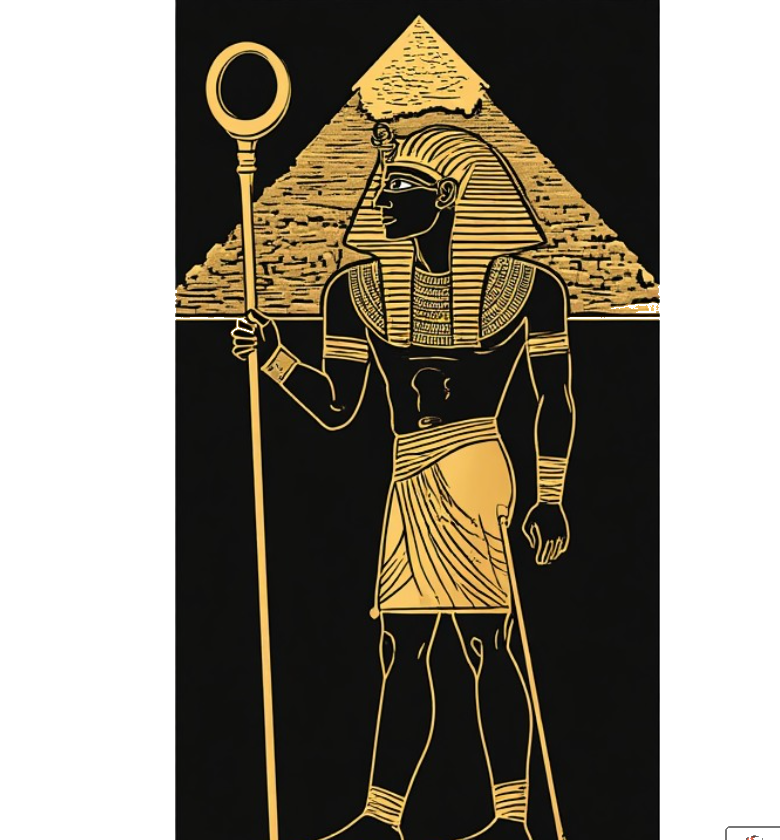
Builder of the eternal mountain, whose ambition pierced the sky.Time has erased his face but not his monument — the last wonder standing.
Domains
Role
Khufu (Greek: Cheops) was the second pharaoh of the Fourth Dynasty (ca. 2589-2566 BCE), the builder of the Great Pyramid at Giza, the largest and most famous pyramid in Egypt and the only one of the Seven Wonders of the Ancient World still standing. Virtually nothing is known of Khufu's actual reign beyond the construction of his pyramid complex, a paradox that has fascinated scholars: the man who built the most massive single structure in the ancient world left behind almost no inscriptional record of his reign. The only confirmed contemporary image of Khufu is a tiny ivory statuette, barely eight centimeters tall, discovered at Abydos — an incongruously modest representation of the builder of the greatest monument on earth.
Significance
Khufu's significance lies in the Great Pyramid itself, which stands as the supreme expression of Old Kingdom pharaonic power, administrative organization, and architectural achievement. The pyramid originally stood 146.6 meters tall and contained approximately 2.3 million limestone blocks, each averaging 2.5 tons. Its construction required the mobilization of a massive workforce (modern estimates suggest 20,000-30,000 workers), the development of sophisticated surveying and engineering techniques, and the organization of a supply chain that quarried and transported stone from across Egypt. The precision of the pyramid's construction — its base is level to within 2.1 centimeters across its 230-meter length — remains a testament to the extraordinary technical capabilities of Old Kingdom Egypt.
Cult & Worship
Khufu's mortuary cult was centered at the pyramid complex at Giza, which included the Great Pyramid itself, a mortuary temple on its eastern face, a causeway descending to a valley temple near the Nile, and several subsidiary pyramids for queens and family members. Five pits for full-sized solar barks were carved into the rock beside the pyramid, two of which contained dismantled cedarwood boats — the "Khufu ships" — presumably intended to carry the king on his celestial journey. The first of these boats, excavated in 1954, is 43 meters long and represents one of the oldest and largest intact vessels from the ancient world. Evidence from the workers' village at Giza, excavated by Mark Lehner and Zahi Hawass, reveals that the pyramid builders were not slaves but paid laborers organized into competing work gangs with names like "Friends of Khufu" and "Drunkards of Menkaure."
Mythological Narratives
Despite the paucity of contemporary sources, Khufu became a significant figure in later Egyptian literary tradition. The "Westcar Papyrus" (Papyrus Berlin 3033), dating to the Middle Kingdom, contains a cycle of tales set in Khufu's court in which magicians perform wonders before the king, culminating in a prophecy about the birth of three future kings who will found the Fifth Dynasty. In this text, Khufu is portrayed as a curious and somewhat imperious ruler, eager to witness magical feats but also capable of cruelty — at one point suggesting that a condemned prisoner be used for a magical demonstration. Herodotus, writing in the fifth century BCE, portrays Khufu (Cheops) as a tyrannical king who forced his people to build the pyramid and even prostituted his own daughter to raise funds, though these accounts are considered unreliable reflections of Greek literary convention rather than historical fact.
Legacy
The Great Pyramid has stood for over four and a half millennia as humanity's most enduring monument, inspiring awe, speculation, and scholarly investigation across the centuries. Ancient Egyptian graffiti from the New Kingdom shows that the pyramid was already a tourist attraction more than a thousand years after its construction. Arab, medieval European, and modern writers have attributed its construction to everyone from biblical figures to extraterrestrial beings, testifying to the persistent human difficulty in accepting that a Bronze Age civilization could achieve such a feat. Modern archaeological and engineering analysis has largely demystified the construction process while only increasing respect for the organizational and technical achievement it represents.
Symbols & Attributes
Sources & References
- The Oxford History of Ancient Egypt (2000)
- Ancient Egypt: Anatomy of a Civilization (2006)
- The Complete Gods and Goddesses of Ancient Egypt (2003)