Deity
Nergal
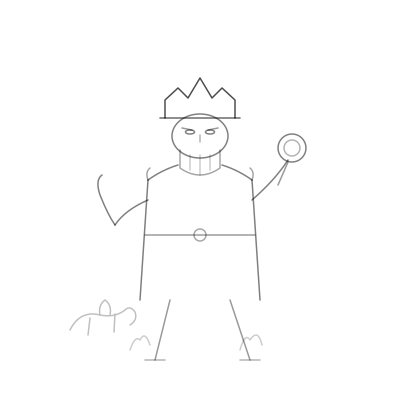
Lord of pestilence and the scorching noon.Where plague walks, he has already passed.
Domains

Role
Nergal is the god of war, plague, death, and the scorching heat of the midday sun, and through his marriage to Ereshkigal, he serves as co-ruler of the Mesopotamian underworld. He embodies the destructive forces of nature in their most lethal forms: the fever that kills in summer, the pestilence that decimates armies, and the violence of warfare. In the Sumerian and Akkadian pantheon, Nergal occupies a unique position as a deity who bridges the celestial and chthonic realms, originally a god of the burning sun who descends to become lord of the dead. His dual nature as both celestial destroyer and underworld sovereign reflects the Mesopotamian understanding of death as an active, aggressive force rather than a passive state.
Significance
Nergal's importance grew considerably during the militaristic Neo-Assyrian period (ca. 911-612 BCE), when his warlike attributes aligned with the ideology of an empire built on conquest. Assyrian kings frequently invoked Nergal alongside Ashur, Ishtar, and other martial deities in their royal inscriptions, crediting him with the destruction of enemy armies and cities. His identification with the planet Mars reinforced his association with war and bloodshed in the astral theology that became increasingly prominent during the first millennium BCE. The theological merging of solar destruction (scorching heat, fever) with underworld sovereignty created a figure of extraordinary dread: Nergal was not merely a god of death but of the active process of dying, of the suffering that precedes the final descent into Ereshkigal's realm.
Cult & Worship
Nergal's primary cult center was at Kutha (modern Tell Ibrahim in central Iraq), where the temple E-meslam ("House of the Underworld") served as his principal shrine and one of the most important sites associated with underworld cult practices in Mesopotamia. The E-meslam was believed to be an entrance to the netherworld itself, giving the temple a uniquely liminal character that set it apart from other Mesopotamian sanctuaries. Kutha's association with the underworld was so strong that the city name became a byword for the realm of the dead in literary texts. Nergal also received worship at temples in Babylon, Nineveh, and other major cities, particularly in contexts related to military campaigns, plague prevention, and funerary rites. Apotropaic rituals invoking Nergal sought to redirect his destructive power away from the worshipper and toward enemies and demons.
Mythological Narratives
The myth of Nergal and Ereshkigal, preserved in two major versions from the Amarna archive (fourteenth century BCE) and from Sultantepe (seventh century BCE), narrates how Nergal came to share sovereignty over the underworld. In the earlier version, Nergal descends to the underworld after offending Ereshkigal by refusing to show respect to her messenger Namtar, and he seizes the throne by force. In the later, more developed version, the narrative includes an extended love affair between Nergal and Ereshkigal: after their initial passionate encounter, Nergal attempts to flee back to heaven, but Ereshkigal threatens to raise the dead to outnumber and devour the living unless he returns. He descends again, storms through the seven gates, and takes his place beside her as king. The two versions illustrate the evolution of Mesopotamian narrative traditions, with the later version introducing psychological complexity and romantic elements absent from the starker early account.
Symbols & Attributes
Sources & References
- Myths from Mesopotamia (2000)
- Gods, Demons and Symbols of Ancient Mesopotamia (1992)