Deity
Ereshkigal
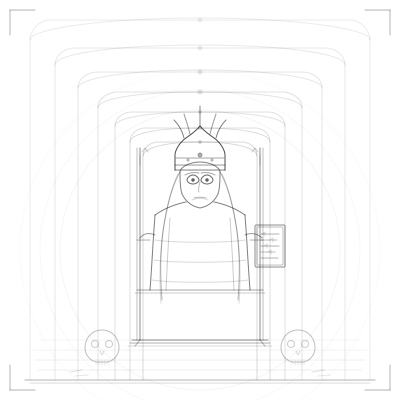
Queen of the great below, who holds what the living surrender.No light reaches her throne. No prayer returns.
Domains

Role
Ereshkigal ("Queen of the Great Earth") is the sole sovereign of the Mesopotamian underworld, ruling over the realm known as Kur, Irkalla, or "the Land of No Return." She is the elder sister of Inanna and the consort of Nergal, though in the earliest traditions she ruled alone, without consort or peer. Her authority within her domain is absolute and uncontested: even the greatest gods must submit to her laws when they enter her realm. In the cosmological distribution of power among the gods, Ereshkigal received dominion over the dead just as Anu received heaven and Enlil the earth, establishing a tripartite cosmic order in which the underworld constitutes an autonomous kingdom with its own laws, court, and divine administrators.
Significance
Ereshkigal represents the absolute finality and impartiality of death in Mesopotamian thought. Unlike later religious traditions that introduced moral judgment in the afterlife, the Mesopotamian underworld received all the dead without distinction: kings and commoners, the righteous and the wicked, all descended to the same grey, dusty realm. Ereshkigal's power is the one force in the cosmos that cannot be circumvented by cleverness, bribery, or divine intervention. When Inanna attempts to challenge her sister's authority by descending to the underworld, she is killed and hung on a hook, demonstrating that Ereshkigal's sovereignty is inviolable. Scholars have noted that Ereshkigal embodies a conception of death as the ultimate equalizer, a cosmic force that stands outside the political hierarchies of the gods and operates according to its own unyielding logic.
Mythological Narratives
In the Descent of Inanna (Sumerian) and the Descent of Ishtar (Akkadian), Ereshkigal strips her sister of all divine power at each of the seven gates of the underworld, removing one garment or piece of jewelry at each threshold until Inanna arrives naked and powerless before her throne. Ereshkigal then fixes the "eye of death" upon Inanna, killing her instantly. This narrative establishes the fundamental Mesopotamian principle that the underworld's laws are universal and absolute. In the myth of Nergal and Ereshkigal, known from both an Amarna-period version (fourteenth century BCE) and a later Neo-Assyrian version, the war god descends to the underworld after insulting Ereshkigal's messenger, and after a violent confrontation that in the later version includes a passionate love affair, he becomes her consort and co-ruler. Enkidu's deathbed vision of the underworld in Tablet VII of the Standard Babylonian Gilgamesh Epic provides one of the most vivid literary descriptions of Ereshkigal's domain, depicting it as a house of dust where the dead sit in darkness, clothed in feathers like birds.
Cult & Worship
Unlike the celestial gods, Ereshkigal did not have major public temples or festival cults. Her worship was primarily conducted through funerary rituals, offerings to the dead (kispu), and incantations designed to propitiate the spirits of the deceased and prevent them from troubling the living. These offerings typically included food, water, and libations poured through clay pipes into the ground, sustaining the dead in their subterranean existence. Ereshkigal was invoked in magical texts dealing with ghosts, necromancy, and communication with the dead. Her gatekeeper, Neti, and her scribe, Belit-seri, appear in ritual texts as intermediary figures through whom the living could petition the underworld's queen. The city of Kutha, where Nergal's temple stood, may have also served as an important center for underworld cult practices by virtue of Nergal's role as Ereshkigal's consort.
Symbols & Attributes
Connections
Rival of Inanna Sisters. Inanna descended to challenge Ereshkigal's realm
Consort of Nergal Nergal stormed the underworld and became her consort
Associated with Kur Queen and ruler of the underworld
Associated with Dumuzi Condemned to spend half the year in the underworld as substitute for Inanna
Associated with Abzu The underworld was conceived as lying beneath and connected to the Abzu
Featured in
Nergal and Ereshkigal
When the warrior god Nergal insults the underworld's envoy, he is sent below to face Ereshkigal's wrath. What begins as punishment becomes a union of equals, and Nergal takes his place as co-ruler of the land of the dead.
lovedeathpowerunderworld
Descent of Inanna
Inanna descends to the underworld to confront her sister Ereshkigal, is killed and hung on a hook, and returns only by sacrificing her husband Dumuzi.
descentdeathresurrectionsacrifice
Sources & References
- Myths from Mesopotamia (2000)
- Inanna, Queen of Heaven and Earth (1983)
- Gods, Demons and Symbols of Ancient Mesopotamia (1992)