Deity
Dumuzi
akkadian Tammuzbabylonian Tammuz
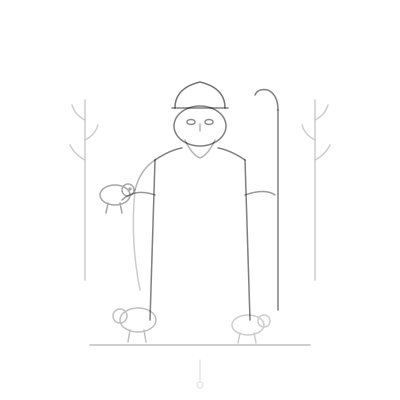
The shepherd-king who paid love's price in the dark below.Spring returns because he does, and dies because he must.
Domains

Role
Dumuzi (Akkadian Tammuz) is the god of shepherds, vegetation, and the seasonal cycle of death and rebirth, and the consort of the goddess Inanna. He occupies a unique and tragic position in the Mesopotamian pantheon: a god of life and fertility who is condemned to spend half of each year in the underworld as the price for his wife's escape from death. His story represents one of the oldest dying-and-rising deity narratives in human history, predating by millennia the similar figures of Adonis, Attis, and Osiris in other Mediterranean traditions. In Sumerian literature, Dumuzi is characterized as a young, beautiful shepherd-king, a figure of pastoral innocence whose destruction at the hands of underworld demons serves as the mythological explanation for the annual withering of vegetation during the scorching Mesopotamian summer.
Significance
Dumuzi's annual death and resurrection mirrors the cycle of the seasons with remarkable precision. His descent to the underworld corresponds to the hot, arid months when pastures dry up and livestock suffer, while his return heralds the renewal of vegetation and the resumption of pastoral life. This cyclical pattern was not merely a literary conceit but was embedded in the ritual calendar of Mesopotamian cities: annual laments for the dead god were performed during the month of Tammuz (roughly June-July), when the summer heat was at its peak. These laments, some of the most beautiful and moving compositions in Sumerian literature, express raw grief over the loss of youth, beauty, and vitality with an emotional intensity that transcends their ritual function. The prophet Ezekiel (8:14) references women weeping for Tammuz at the gates of the Jerusalem temple, attesting to the remarkable spread of his cult beyond Mesopotamia into the Levant.
Mythological Narratives
In the Descent of Inanna, Dumuzi's condemnation is both shocking and psychologically complex. When Inanna returns from the underworld, she must provide a substitute to take her place among the dead. She passes through the cities of Sumer, and at each she encounters a god or official in mourning for her absence, whom she spares. But when she reaches Uruk and finds Dumuzi seated comfortably on her throne, dressed in fine garments and showing no signs of grief, she fixes upon him the "eye of death" and condemns him to the demons. Dumuzi's sister Geshtinanna, moved by devotion, offers to share his fate, and so each spends half the year in the land of the dead. A separate cycle of poems, the "Dumuzi's Dream" compositions, narrates Dumuzi's desperate attempts to flee the underworld demons (galla), aided by his sister and the sun god Utu, who transforms him into a gazelle. Despite these divine interventions, the demons eventually capture him, and his descent into death is accomplished with terrible inevitability.
Cult & Worship
The cult of Dumuzi was among the most emotionally charged in Mesopotamian religious practice. Annual ritual laments were performed during the summer months, primarily by women, who bewailed the death of the young god in formalized but deeply affecting compositions. These laments, preserved in Sumerian literary texts from the Old Babylonian period, describe the desolation of the sheepfold without its shepherd, the drying of the pastures, and the grief of Inanna and Geshtinanna with lyrical power. The "Sacred Marriage" (hieros gamos) ceremony, in which the king symbolically united with Inanna to ensure the fertility of the land, cast the king in the role of Dumuzi, linking the god's mythological fate to the annual cycle of royal renewal. Evidence from the Ur III period and the Isin-Larsa dynasties suggests that these ceremonies were performed with great pomp and were central to the political-religious ideology of Sumerian kingship. Under his Akkadian name Tammuz, the mourning rituals spread throughout the ancient Near East and persisted for centuries, outlasting Mesopotamian political independence itself.
Symbols & Attributes
Connections
Sources & References
- Inanna, Queen of Heaven and Earth (1983)
- The Treasures of Darkness (1976)