Deity
Inanna
akkadian Ishtarbabylonian Ishtar
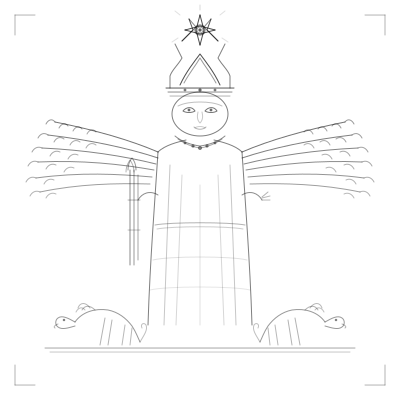
Queen of heaven and earth, fierce in love, terrible in war.She descends and rises. Death cannot hold her.
Role
Inanna (Akkadian Ishtar) is the goddess of love, war, beauty, desire, fertility, political power, and the planet Venus, making her the most multifaceted and complex deity in the Mesopotamian pantheon. She defies easy categorization: she is simultaneously the tender beloved of Dumuzi and the terrifying warrior who wades through blood on the battlefield, the patron of sexual desire and the cold-eyed judge who condemns her own husband to the underworld. In the Sumerian theological system, she holds a unique position as the only major deity who actively transgresses cosmic boundaries, descending to the underworld, ascending to heaven, and continually expanding her own power by seizing prerogatives from other gods. Her personality in the literary texts is vividly drawn, passionate, willful, imperious, and capable of both exquisite tenderness and devastating rage.
Significance
Inanna is one of the most extensively documented deities from the ancient world, with a literary corpus that dwarfs that of any other Mesopotamian goddess. The hymns of Enheduanna, the high priestess of Nanna at Ur and the world's first named author (ca. 2300 BCE), include passionate devotional works such as "The Exaltation of Inanna" (nin-me-sar-ra) and "Lady of Largest Heart" (in-nin-sa-gur-ra), which establish Inanna as a cosmic force beyond the control of the other gods. Her myth cycle addresses fundamental questions about power, desire, death, and transformation. The Descent of Inanna to the Underworld is among the oldest surviving literary narratives in human history, composed in Sumerian during the late third millennium BCE and later adapted into the Akkadian Descent of Ishtar.
Cult & Worship
Inanna's primary cult center was the Eanna ("House of Heaven") temple in Uruk, one of the largest and most architecturally ambitious temple complexes in all of Mesopotamia, with monumental structures dating to the late Uruk period (ca. 3500-3100 BCE). The Eanna precinct housed an extensive bureaucracy and was a major economic institution in its own right, administering agricultural lands, workshops, and trade networks. Her worship involved elaborate rituals including the sacred marriage ceremony (hieros gamos), in which the king symbolically united with the goddess to ensure fertility and prosperity for the land, a practice documented in royal hymns from the Ur III and Isin-Larsa periods. Festival processions carried her image through the streets of Uruk, accompanied by music, dance, and the performance of hymns and laments. Under her Akkadian name Ishtar, her worship spread throughout the Near East, with major temples in Nineveh, Arbela, and Assur, and her cult persisted well into the first millennium BCE.
Mythological Narratives
The Descent of Inanna is the centerpiece of her myth cycle. She descends to the underworld to confront her sister Ereshkigal, passing through seven gates and being stripped of one article of clothing or jewelry at each, until she arrives naked and powerless before the throne of death. Ereshkigal kills her and hangs her corpse on a hook, but Enki engineers her rescue by sending two genderless beings who restore her to life with the food and water of life. However, no one may leave the underworld without providing a substitute, and when Inanna finds Dumuzi sitting comfortably on her throne rather than mourning her absence, she condemns him to take her place. In "Inanna and Enki," she travels to Eridu and, through a night of revelry, tricks Enki into surrendering the me, the divine decrees of civilization, which she carries triumphantly back to Uruk. These narratives portray a goddess who refuses to accept limits on her power and who repeatedly reshapes the cosmic order through sheer force of will.
Historical Context
Inanna's cult is among the oldest attested in Mesopotamia, with evidence of her worship at Uruk stretching back to the fourth millennium BCE. The famous Warka Vase (ca. 3200 BCE), one of the earliest known narrative relief sculptures, depicts a procession bringing offerings to Inanna's temple. Her importance only grew over time: under the Akkadian dynasty, Sargon of Akkad installed his daughter Enheduanna as high priestess of Nanna at Ur, a position from which Enheduanna composed her influential hymns to Inanna. During the Neo-Assyrian period, Ishtar of Nineveh and Ishtar of Arbela served as two of the most important oracular deities, delivering prophecies to the king through ecstatic priestesses. Her influence extended beyond Mesopotamia, with the Phoenician Astarte, the Greek Aphrodite, and the Roman Venus all bearing traces of her complex theological legacy.
Symbols & Attributes
Connections
Child of Anu Grandfather figure to Inanna
Child of Nanna Father of Inanna
Consort of Dumuzi Husband of Inanna, sent to the underworld in her place
Rival of Ereshkigal Sisters. Inanna descended to challenge Ereshkigal's realm
Rival of Gilgamesh Gilgamesh rejected Inanna's advances, triggering her wrath and the Bull of Heaven episode
Associated with Me Inanna stole the me (divine decrees) from Enki and brought them to Uruk
Featured in
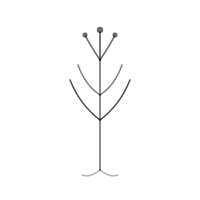
Inanna and the Huluppu Tree
Inanna rescues a sacred huluppu tree from three sinister creatures, and with Gilgamesh's aid, the tree is felled to craft her throne and bed, while its remnants become the legendary pukku and mikku.
originskingshipdivine-gifts
Descent of Inanna
Inanna descends to the underworld to confront her sister Ereshkigal, is killed and hung on a hook, and returns only by sacrificing her husband Dumuzi.
descentdeathresurrectionsacrifice
Epic of Gilgamesh
The world's oldest epic. A king's journey from arrogance through friendship, loss, and a futile quest for immortality, ending in hard-won acceptance.
mortalityfriendshipquestlosskingship
Sources & References
- Inanna, Queen of Heaven and Earth (1983)
- The Treasures of Darkness (1976)
- Gods, Demons and Symbols of Ancient Mesopotamia (1992)