Deity
Anu
sumerian An
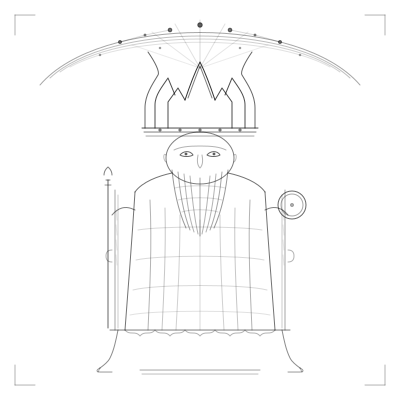
Father of the heavens, throne above all thrones.His silence is law, his distance is authority itself.
Role
Anu (Sumerian An) stands at the apex of the Mesopotamian divine hierarchy as supreme god of the heavens, the ultimate source from which all divine and royal authority flows. In the Sumerian theological system, his name is literally the word for "heaven," collapsing the distinction between the god and the cosmic domain he personifies. He is the father of the great gods, including Enlil, Enki, and in some traditions Inanna, and the progenitor of the Anunnaki, the assembly of divine judges. Despite his supreme rank, Anu is a largely passive figure in mythological narratives, delegating executive power to Enlil and later to Marduk, a pattern that scholars like Thorkild Jacobsen have interpreted as reflecting the transition from chieftain-based to more bureaucratic forms of governance in Mesopotamian society.
Significance
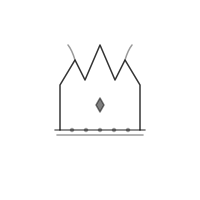
Anu's authority underwrites the entire structure of divine and earthly power, though he seldom intervenes directly in mortal or divine affairs. The "Anu-power" (Akkadian anutum) was a theological concept denoting supreme sovereignty that could be bestowed upon other gods, most notably when Marduk receives it in the Enuma Elish. In god lists such as the canonical An = Anum series, Anu heads the pantheon with hundreds of associated deities organized under his authority. His horned crown, the most sacred symbol of divinity in Mesopotamian iconography, became the standard marker for any divine being in cylinder seal art and votive sculpture from the third millennium BCE onward.
Cult & Worship
Anu's primary cult center was the ancient city of Uruk, where the Eanna ("House of Heaven") temple complex was originally dedicated to him before becoming more closely associated with his daughter Inanna during the late fourth millennium BCE. The Bit Resh temple in Uruk, rebuilt during the Seleucid period in the third century BCE, remained an active center of Anu worship, making it one of the longest-enduring sites of continuous religious devotion in the ancient world. Archaeological excavations at Uruk have revealed that the Eanna precinct was among the largest sacred complexes in all of Mesopotamia, with monumental architecture dating back to the Uruk period (ca. 4000-3100 BCE). Ritual texts from the Seleucid era describe elaborate daily offerings to Anu including bread, beer, dates, and sheep, along with seasonal festivals that brought the entire city into ceremonial participation.
Mythological Narratives
Though Anu rarely appears as an active protagonist, his decisions set critical mythological events into motion. In the Epic of Gilgamesh, it is Anu who authorizes the creation of the Bull of Heaven at Inanna's insistence, unleashing catastrophe upon Uruk as punishment for Gilgamesh's rejection of the goddess. In the Myth of Adapa, Anu summons the sage to heaven after Adapa breaks the wing of the South Wind, and it is Anu who offers the food and water of immortality that Adapa, on Enki's deceptive counsel, refuses. The Descent of Inanna recounts that it is Anu's cosmic authority that establishes the laws governing the underworld, laws so absolute that even his own granddaughter cannot transgress them without consequence. These narrative patterns establish Anu as the silent architect of cosmic order whose will shapes events even when he stands apart from them.
Symbols & Attributes
Connections
Featured in
Nergal and Ereshkigal
When the warrior god Nergal insults the underworld's envoy, he is sent below to face Ereshkigal's wrath. What begins as punishment becomes a union of equals, and Nergal takes his place as co-ruler of the land of the dead.
lovedeathpowerunderworld
Enuma Elish
The Babylonian creation epic. Marduk defeated the primordial chaos goddess Tiamat and fashioned the cosmos from her body.
creationcosmic-battlekingship
Myth of Adapa
The sage Adapa is summoned to heaven after breaking the south wind's wing, but Enki's deceptive advice costs him the chance at immortality.
wisdommortalitydeception
Sources & References
- Gods, Demons and Symbols of Ancient Mesopotamia (1992)
- The Treasures of Darkness (1976)