Deity
Enlil
akkadian Ellil
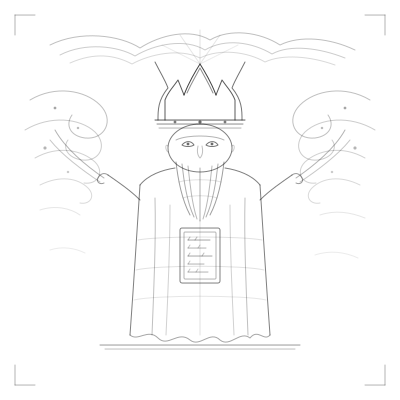
Lord of wind and command, whose word stirs both storm and silence.The breath between creation and destruction.


Role
Enlil is the god of wind, air, earth, and storms, and for most of the third millennium BCE he served as the most powerful active deity in the Sumerian pantheon. While Anu held nominal supremacy, it was Enlil who wielded executive authority over both divine and mortal realms, carrying out the decrees of the divine assembly and commanding the forces of nature. He possessed the Tablets of Destiny, the divine artifact that conferred absolute control over the fates of all beings. In the Sumerian theological framework, Enlil's word was irrevocable: once he pronounced a decree, no god could alter it, a concept that made him both the guarantor of cosmic order and, at times, its most terrifying enforcer.
Significance
Enlil's theological importance can hardly be overstated. He was the deity who separated heaven from earth at the beginning of creation, an act described in the Sumerian composition "Enlil and the Creation of the Pickaxe." He granted kingship to mortal rulers and could revoke it at will, making him the divine patron of legitimate political authority throughout Sumer and Akkad. His decrees shaped the rise and fall of entire dynasties: the destruction of Ur at the end of the Ur III period was lamented as a consequence of Enlil's terrible judgment. Jacobsen characterized Enlil as embodying "authority" in its most elemental form, a force that compels obedience not through persuasion but through the sheer weight of command.
Cult & Worship
Enlil's seat of power was the Ekur ("Mountain House") temple in Nippur, the spiritual capital of Sumer. Nippur held a unique position among Mesopotamian cities: it was not the seat of any secular dynasty, functioning instead as a purely religious center whose approval was necessary for any king to claim legitimate rule. Archaeological excavations at Nippur, conducted by the University of Pennsylvania since the late nineteenth century, have revealed continuous occupation and temple activity spanning from the Ubaid period through the Parthian era. The Ekur complex included multiple courtyards, chapels, and a ziggurat, and thousands of cuneiform tablets recovered from the site constitute one of the most important archives of Sumerian literary and administrative texts. During major festivals, offerings to Enlil at the Ekur were among the most lavish in all of Mesopotamia, reflecting his preeminent status among the gods.
Historical Context
During the third millennium BCE, Enlil was the undisputed chief of the active pantheon. Kings from Akkad, Ur, Isin, and Larsa all sought legitimacy through Enlil's blessing at Nippur, and royal hymns frequently celebrated the ruler's special relationship with the god. The Ur III kings Ur-Nammu and Shulgi invested heavily in the Ekur, and the "Hymn to Enlil" composed during this period is one of the most elaborate theological texts in Sumerian literature. Enlil's position gradually declined with the political rise of Babylon in the early second millennium BCE, when Marduk absorbed many of his roles and prerogatives as part of the theological restructuring reflected in the Enuma Elish. However, Enlil never disappeared entirely: under his Akkadian name Ellil, he continued to be venerated in Assyria, and his attributes and epithets were transferred to Marduk and later to Ashur, ensuring his theological legacy persisted throughout Mesopotamian history.
Mythological Narratives
Enlil figures prominently in several major Sumerian literary compositions. In "Enlil and Ninlil," he seduces the young goddess Ninlil beside the waters of Nippur and is banished to the underworld as punishment, though Ninlil follows him, resulting in the conception of the moon god Nanna and several underworld deities. In the Atrahasis epic, it is Enlil who grows enraged at the noise of overpopulating humanity and sends plague, drought, and ultimately the great flood to destroy them, only to be outwitted by Enki's warning to the flood hero. This portrayal of Enlil as both creator and destroyer, nurturing father and wrathful judge, reflects the Mesopotamian understanding of divine power as fundamentally ambivalent, capable of sustaining civilization or annihilating it without contradiction.
Symbols & Attributes
Connections
Child of Anu Father of Enlil
Parent of Nanna Father of Nanna the moon god
Parent of Ninurta Father of Ninurta
Consort of Ninhursag Consort in some traditions
Associated with Igigi The Igigi rebelled against Enlil's labor demands, leading to the creation of humanity
Associated with Anunnaki Led by Enlil in many traditions
Associated with Ekur Enlil's great temple in Nippur
Featured in
Nergal and Ereshkigal
When the warrior god Nergal insults the underworld's envoy, he is sent below to face Ereshkigal's wrath. What begins as punishment becomes a union of equals, and Nergal takes his place as co-ruler of the land of the dead.
lovedeathpowerunderworld
Flood of Utnapishtim
The gods send a devastating flood to destroy humanity. Enki secretly warns Utnapishtim, who builds an ark and survives, earning immortality from the repentant gods.
floodsurvivaldivine-judgment
Sources & References
- The Treasures of Darkness (1976)
- The Sumerians: Their History, Culture, and Character (1963)
- Religion in Ancient Mesopotamia (2001)