Deity
Ninhursag
akkadian Nintubabylonian Belet-ili
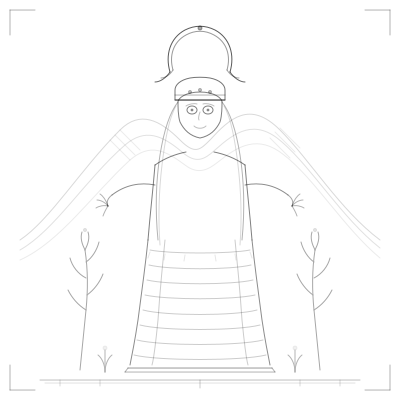
Mother of the stony ground, nurser of kings.From her body, the land itself takes shape.
Role
Ninhursag ("Lady of the Sacred Mountain") is the great mother goddess of Mesopotamia, one of the seven supreme deities of the Sumerian pantheon alongside Anu, Enlil, Enki, Nanna, Utu, and Inanna. She presides over fertility, birth, nature, and the wild animals of the steppe and mountain. As a birth goddess, she is responsible for shaping human beings in the womb, fashioning their limbs and organs from clay in concert with Enki. Her role as divine midwife and mother of the gods gives her a primordial authority that transcends the political hierarchies of the male gods, making her one of the most ancient and revered figures in Mesopotamian religion. In the god lists, her position among the highest-ranking deities remained stable across millennia, even as her cult received less royal patronage than that of the male members of the supreme triad.
Significance
Ninhursag represents the earth's generative power in its most elemental form. She is the mother who shapes both gods and mortals, the nurse who suckles kings, and the wild force of the uncultivated landscape. In the myth of "Enki and Ninhursag," set in the pristine paradise of Dilmun, she creates eight healing deities from Enki's afflicted body parts after he falls ill from consuming forbidden plants, a narrative that some scholars including Samuel Noah Kramer have linked to the biblical story of Eve's creation from Adam's rib. Her epithet "Mother of the Gods" (Sumerian ama-dingir-ene) was no mere honorific: theological texts describe her as physically giving birth to the Anunnaki and nursing the earliest generations of divine beings. Her power over the formation of life in the womb made her an essential figure in prayers, incantations, and rituals associated with pregnancy and childbirth throughout Mesopotamian history.
Cult & Worship
Ninhursag was known by many names across Mesopotamian history, including Ninmah ("Exalted Lady"), Nintu ("Lady of Birth"), Belet-ili ("Mistress of the Gods"), and Ki ("Earth"), reflecting her fundamental importance and the multiplicity of her aspects. Her temple at Tell al-Ubaid near Ur, dating to the Early Dynastic period (ca. 2600 BCE), is one of the most important archaeological discoveries for understanding early Sumerian religious architecture, featuring a remarkable copper relief panel depicting the Imdugud (lion-headed eagle) grasping two stags. She also had significant temples at Kesh, celebrated in the "Hymn to Kesh" as one of the most important sanctuaries in Sumer, and at Adab. Unlike the cults of Inanna or Nanna, her worship tended to be less politically prominent but more deeply embedded in the daily life of ordinary people, particularly in rituals surrounding childbirth and the protection of mothers and infants.
Mythological Narratives
In the Atrahasis epic, Ninhursag (as Nintu/Mami) plays a crucial role in the creation of humanity, mixing clay with the blood of the slaughtered god We-ilu and shaping fourteen pieces of clay into seven male and seven female humans. She is described as pinching off the clay and reciting incantations as she works, establishing the ritual procedures that human midwives would later follow. In "Enki and Ninhursag," her relationship with the water god is both generative and contentious: she creates and curses, heals and withholds, demonstrating the ambivalence of the earth's fertility, which gives life but can also deny it. Akkadian birth incantations from the first millennium BCE continued to invoke her by her various names, calling upon her to ease difficult labors and protect newborns from demonic attack. Her role in the Sumerian poem "The Song of the Hoe" associates her with the agricultural landscape itself, the mother whose body is the ground that feeds civilization.
Symbols & Attributes
Connections
Sources & References
- The Treasures of Darkness (1976)
- The Sumerians: Their History, Culture, and Character (1963)