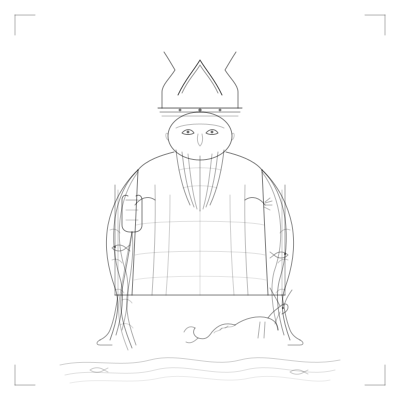
Deity

Enki

akkadian Eababylonian Ea
Keeper of the sacred waters, architect of wisdom.He who shapes the world not with force, but with knowing.


Role

Enki (Akkadian Ea) is the god of freshwater, wisdom, crafts, magic, and creation, and the master of the abzu, the primordial subterranean freshwater ocean from which all springs, rivers, and marshes were believed to originate. He is one of the triad of supreme gods alongside Anu and Enlil, though his power operates through intelligence, cunning, and creative skill rather than brute authority. Enki is the divine craftsman and problem-solver par excellence, the god to whom both humans and gods turn when situations require ingenuity rather than force. His domain encompasses the me, the fundamental divine powers and cultural norms that make civilized life possible, which he guards in his underwater temple and dispenses as he sees fit.

Significance

Enki's theological role is uniquely complex: he is simultaneously the creator of humanity, its most consistent advocate, and the keeper of the cosmic knowledge that separates divine from mortal existence. In the Atrahasis epic, it is Enki who devises the plan to create humans from clay mixed with the blood of a slaughtered god, fashioning mortal workers to relieve the Igigi of their labor. When Enlil later sends the great flood to destroy humanity, Enki circumvents the divine decree by warning the flood hero through the wall of his reed hut, a brilliant act of technical obedience and practical defiance that preserves the human race. Jacobsen identified Enki as embodying the "trickster" archetype in Mesopotamian theology, a figure whose cleverness serves as the essential counterbalance to the rigid authority of Enlil.

Cult & Worship

Enki's principal temple was the E-abzu ("House of the Deep Waters") in Eridu, considered in Sumerian tradition to be the oldest and most sacred city in the world. The Sumerian King List names Eridu as the place where kingship first descended from heaven, and archaeological excavations at the site (modern Abu Shahrain in southern Iraq) have confirmed continuous occupation from approximately 5400 BCE, supporting its mythological status as the first city. The temple sequence at Eridu, spanning eighteen levels of construction, represents one of the longest continuous records of religious architecture in human history. Rituals at the E-abzu involved elaborate water ceremonies, purification rites, and incantations that drew on Enki's association with the cleansing and life-giving properties of freshwater. Under his Akkadian name Ea, his cult spread throughout Babylonia and Assyria, and he became particularly important in the tradition of exorcism and magical healing.

Mythological Narratives

Enki features as the protagonist or key figure in an extraordinary number of Sumerian and Akkadian literary compositions. In "Enki and the World Order," he organizes the cosmos by assigning each god a specific domain and function, acting as the divine administrator who transforms raw creation into an ordered civilization. In "Enki and Ninhursag," set in the paradise of Dilmun, he eats forbidden plants and falls mortally ill until Ninhursag creates eight healing deities from his afflicted body parts, a narrative that some scholars have connected to the later Eden story in Genesis. In "Inanna and Enki," the goddess of love visits Enki in Eridu, and after a night of drinking, he bestows upon her the me, the civilizational decrees, which she carries back to Uruk in her Boat of Heaven. His role in the Gilgamesh flood narrative and the Atrahasis epic cements his position as humanity's divine patron, the god who consistently subverts the destructive intentions of the divine assembly to preserve mortal life.

Legacy

Enki's influence extended far beyond Mesopotamia proper. Under his Akkadian name Ea, he remained central to Babylonian and Assyrian theology for millennia, serving as the patron deity of the ashipu (exorcist-priests) whose incantation literature formed one of the most extensive textual corpora of the ancient Near East. The "Marduk-Ea" incantation formula, in which Marduk consults his father Ea about how to heal a patient, became the standard framework for Mesopotamian magical healing texts. Enki's symbol of flowing water and his association with the goat-fish (a creature later linked to the zodiacal sign Capricorn) persisted into Hellenistic astrology, carrying fragments of Mesopotamian theological thought into the wider Mediterranean world.
water-streamsgoat-fishturtleram-headed-staff

Sources & References

  • The Sumerians: Their History, Culture, and Character Kramer, Samuel Noah (1963)
  • Religion in Ancient Mesopotamia Bottéro, Jean (2001)
  • The Treasures of Darkness Jacobsen, Thorkild (1976)