Deity
Marduk
sumerian Asar-lu-hi
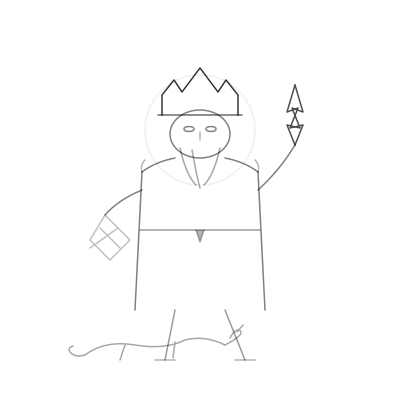
Slayer of chaos, shaper of the cosmos from the body of the deep.Babylon's champion, crowned in the blood of primordial war.


Role
Marduk is the chief deity of Babylon, a storm god and divine warrior who rose from relative obscurity as a local city god to become the supreme deity of the entire Mesopotamian pantheon. His ascent is narrated in the Enuma Elish, the Babylonian creation epic, in which he defeats the primordial sea goddess Tiamat and fashions the cosmos from her divided body. In theological terms, Marduk inherited and absorbed the powers of all the older gods, receiving fifty divine names that collectively encompass every aspect of divine sovereignty. He is at once sky god, water god, storm god, healer, judge, and king of the gods, a theological synthesis that reflects Babylon's political ambition to be the center of the known world.
Significance
Marduk represents the theological legitimization of Babylon's political hegemony. The Enuma Elish is not merely a creation myth but a political-theological charter: by demonstrating that Marduk created the cosmos and organized the gods, it justifies Babylon's claim to be the capital of the world and its king the chosen representative of the supreme god. The text was composed during the Kassite or early Isin II period (late second millennium BCE) and drew upon older Sumerian cosmogonic traditions, systematically replacing Enlil and other gods with Marduk. The fifty names bestowed upon Marduk at the end of the epic represent a deliberate program of theological syncretism, absorbing the attributes of Enlil (authority), Ea (wisdom), Shamash (justice), and others into a single supreme figure. This theological revolution parallels similar processes in other ancient cultures but is remarkable for its explicit, self-conscious character.
Cult & Worship
Marduk's cult center was the Esagila temple complex in Babylon, one of the largest and most opulent sacred precincts in the ancient world. Adjacent to it stood the ziggurat Etemenanki, widely believed to be the inspiration for the biblical Tower of Babel. Each spring during the twelve-day Akitu (New Year) festival, the Enuma Elish was ritually recited in its entirety, and the reigning king's authority was symbolically renewed through a humiliation ritual in which he was stripped of his regalia, struck across the face by a priest, and forced to declare his innocence before Marduk's statue. Only after grasping the hands of the god's image was royal power restored for another year. The Akitu festival was so central to Babylonian identity that its interruption during periods of foreign occupation was recorded as a national catastrophe. Nebuchadnezzar II extensively rebuilt and adorned the Esagila complex during the sixth century BCE, making it one of the wonders of the ancient world described by Herodotus.
Mythological Narratives
The Enuma Elish narrates Marduk's rise in vivid detail. When Tiamat raises an army of eleven cosmic monsters to destroy the younger gods, the divine assembly turns in desperation to Marduk, who agrees to fight on one condition: that he be granted supreme and irrevocable authority over all the gods. Armed with the winds, a net, a bow, and a mace, he confronts Tiamat, drives the Evil Wind into her open mouth, and splits her body in two. From one half he creates the sky, from the other the earth; from her eyes flow the Tigris and Euphrates. He then organizes the cosmos, assigns the gods their stations, and creates humanity from the blood of the defeated Kingu to serve as laborers for the gods. The narrative is structured in seven tablets, likely corresponding to the seven days of the Akitu festival during which it was performed, creating a ritual reenactment of cosmic creation.
Legacy
Marduk's rise from a local city god to supreme deity mirrors Babylon's own political ascent under Hammurabi in the eighteenth century BCE and its subsequent consolidation as the cultural center of Mesopotamia. His theological dominance persisted through the Neo-Babylonian period, when Nebuchadnezzar II and Nabonidus both defined their reigns in relation to Marduk's cult. When Cyrus the Great conquered Babylon in 539 BCE, he issued the famous Cyrus Cylinder, which justified his conquest by claiming that Marduk himself had chosen Cyrus as his instrument because the last Babylonian king Nabonidus had neglected the god's worship. This remarkable document demonstrates that even foreign conquerors recognized the necessity of legitimizing their rule through Marduk's divine authority. Greek authors including Herodotus recorded descriptions of Marduk's temple and cult, transmitting knowledge of Babylonian religion into the classical tradition.
Symbols & Attributes
Connections
Child of Enki Father of Marduk
Slayer of Tiamat Slew Tiamat to create the world
Slayer of Kingu Executed Kingu; humanity made from his blood
Parent of Nabu Father of Nabu
Associated with Esagila His great temple in Babylon
Associated with Anunnaki After defeating Tiamat, Marduk reorganized the Anunnaki between heaven and underworld
Sources & References
- Myths from Mesopotamia (2000)
- Religion in Ancient Mesopotamia (2001)
- Gods, Demons and Symbols of Ancient Mesopotamia (1992)