Deity
Kingu
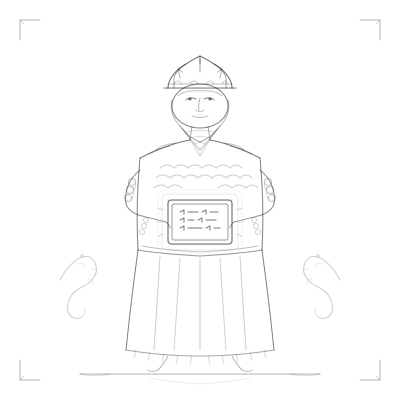
Bearer of the Tablet, champion of the mother-sea.His blood was the price of human breath.
Domains

Role
Kingu is the consort of Tiamat and the commander of her monstrous army in the Enuma Elish, the Babylonian creation epic. Tiamat elevates him above all other gods in her host, granting him the Tablet of Destinies, the most powerful divine artifact in Mesopotamian cosmology, which confers supreme authority over the fates of all beings. His appointment as Tiamat's champion and generalissimo transforms him from a minor deity into a figure of cosmic significance, though his role is ultimately defined by his defeat. In the theological structure of the Enuma Elish, Kingu serves as the necessary sacrificial figure whose destruction enables the creation of humanity.
Significance
After Marduk defeats Tiamat and scatters her forces, Kingu is captured, bound, and brought before the divine assembly for judgment. Ea (Enki) severs his blood vessels, and from his blood humanity is fashioned, a creation act that permanently binds mortals to a condition of servitude to the gods. This theological claim that humans are made from the substance of a condemned rebel god carries profound implications: humanity inherits both divine essence and the taint of transgression, a duality that some scholars have compared to later doctrines of original sin. The creation of humans from Kingu's blood specifically serves the practical purpose of relieving the Igigi gods of their labor, establishing the Mesopotamian understanding that human existence is fundamentally one of toil on behalf of the divine.
Mythological Narratives
In the Enuma Elish, Kingu's elevation by Tiamat is described with ceremonial grandeur: she seats him on a throne, declares him her spouse, and fastens the Tablet of Destinies upon his chest, proclaiming that his command shall be unchangeable. Yet when Marduk confronts Tiamat's forces, Kingu and the other gods in her army are immediately paralyzed with terror, their battle formations collapsing before the fight even begins. This contrast between Kingu's exalted investiture and his inglorious defeat serves a clear rhetorical purpose within the epic: it demonstrates that authority not backed by genuine power is hollow, and that Marduk's supremacy is absolute. Kingu's blood, mixed with clay by Ea, becomes the material from which the god Nintu shapes the first human beings, establishing the link between cosmic violence and the origin of mortal life.
Legacy
Kingu's narrative role places him at one of the most critical junctures in Mesopotamian cosmology: the transition from divine labor to human servitude. Earlier traditions, such as the Atrahasis epic, attribute the creation of humanity to the blood of an unnamed slaughtered god (the Alla or We-ilu), but the Enuma Elish specifically identifies this sacrificial figure as Kingu, linking the act of creation to the defeat of chaos. This theological innovation ties the origin of humanity not merely to divine will but to the aftermath of cosmic war, suggesting that human existence is inseparable from the violence that brought the ordered cosmos into being. Kingu thus occupies a paradoxical position: he is both villain and progenitor, the defeated rebel whose substance flows through every mortal being.
Symbols & Attributes
Connections
Sources & References
- Myths from Mesopotamia (2000)