Deity
Nanna
akkadian Sinbabylonian Sin
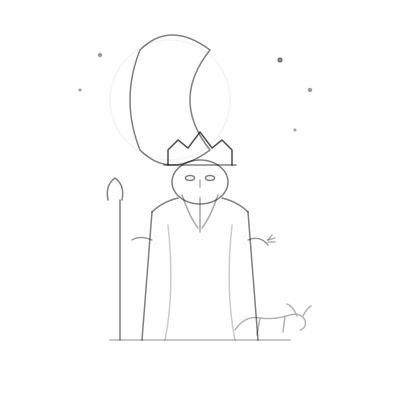
Silver light on the marshes, keeper of months and tides.The wandering lamp that measures the passage of all things.
Domains

Role
Nanna (Akkadian Sin) is the moon god, lord of the calendar, keeper of time, and one of the most important astral deities in the Mesopotamian pantheon. He is the son of Enlil and Ninlil, conceived during Enlil's banishment to the underworld as narrated in the Sumerian myth "Enlil and Ninlil." Nanna is the father of two of the most prominent deities in the pantheon: Utu-Shamash, the sun god, and Inanna-Ishtar, the goddess of love and war. In the Mesopotamian cosmological scheme, the moon held precedence over the sun, a hierarchy reflected in Nanna's position as the father who generates the solar light. His crescent symbol was one of the most ubiquitous divine emblems in Mesopotamian art, appearing on cylinder seals, boundary stones (kudurru), and royal stelae across three millennia.
Significance
The lunar calendar was fundamental to every aspect of Mesopotamian life, governing agricultural cycles, religious festivals, economic transactions, and the computation of time itself. Nanna's monthly cycle of waxing and waning provided the basic framework for the Mesopotamian calendrical system, and his disappearance during the new moon was interpreted as a journey to the underworld, prompting ritual laments and protective ceremonies. Eclipses were regarded as especially ominous events, interpreted as attacks on Nanna by demonic forces, and elaborate rituals of intercession were performed to aid the god during these cosmic crises. The association of the moon with cattle herding is ancient and deep: Nanna was frequently described as a "young bull" or a "frisky calf," and his crescent was imagined as the horns of a cosmic bull traversing the night sky.
Cult & Worship
Nanna's principal temple was the E-kishnugal ("House of the Great Light") in Ur, one of the most important religious centers in all of Sumer. The great ziggurat of Ur, extensively rebuilt by Ur-Nammu and his son Shulgi during the Ur III period (ca. 2112-2004 BCE), is one of the best-preserved ziggurats in Mesopotamia and stands today as an iconic monument of ancient architecture. The Ur III dynasty cultivated an especially close relationship with Nanna, and Shulgi composed elaborate hymns praising both the god and his own divinely ordained kingship. The high priestess of Nanna at Ur was one of the most prestigious religious offices in Mesopotamia: Sargon of Akkad appointed his daughter Enheduanna to this position, and the practice of royal women serving as en-priestesses of Nanna continued for centuries. Under his Akkadian name Sin, his worship at Harran in northern Mesopotamia became a major cult center that persisted into the Roman period, with the last known pagan temple to Sin remaining active well into the Christian era.
Historical Context
Nanna's importance extended well beyond the purely religious sphere. The city of Ur, under his patronage, became one of the wealthiest and most powerful cities in southern Mesopotamia, particularly during the Ur III period when it served as the capital of an empire stretching from the Persian Gulf to the Zagros Mountains. The "Lament for the Destruction of Ur," composed after the city's fall to the Elamites and Amorites around 2004 BCE, is one of the most moving literary works of antiquity, describing how Nanna's city was laid waste and its people scattered despite the moon god's desperate pleas to Enlil and Anu for mercy. Archaeological discoveries at Ur by Leonard Woolley in the 1920s, including the spectacular Royal Tombs dating to the Early Dynastic period, revealed the extraordinary wealth and ritual sophistication of a city devoted to the moon god for millennia.
Symbols & Attributes
Connections
Sources & References
- The Sumerians: Their History, Culture, and Character (1963)
- Gods, Demons and Symbols of Ancient Mesopotamia (1992)