Deity
Utu
akkadian Shamashbabylonian Shamash
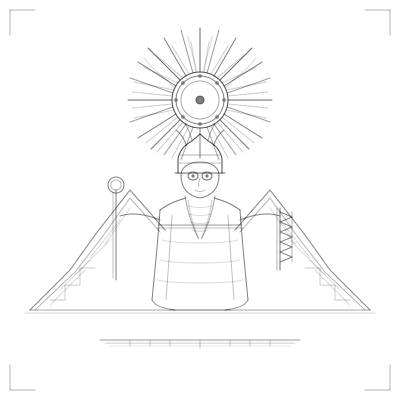
He who sees all, whose light reveals truth and burns away deceit.Judge of heaven and earth, rider of the blazing chariot.


Role
Utu (Akkadian Shamash) is the sun god and divine judge, the supreme arbiter of truth, justice, and moral order in the Mesopotamian pantheon. Son of the moon god Nanna and brother of Inanna, Utu travels across the sky each day in his solar chariot and descends through the underworld each night, a journey that gives him unique knowledge of both the living and the dead. His penetrating light was understood not merely as a physical phenomenon but as a moral force: sunlight exposes what darkness conceals, and Utu's gaze was believed to reveal all hidden things, including lies, injustice, and secret wrongdoing. In Sumerian hymns, he is addressed as the shepherd of the people and the guide of lost travelers, the deity who illuminates both the physical and moral landscape.
Significance
Utu-Shamash occupied a central position in Mesopotamian concepts of justice and law. His association with legal proceedings was not merely symbolic: courts in ancient Mesopotamia frequently convened at sunrise, under the god's watchful eye, and oaths were sworn in his name to ensure truthfulness. The famous Code of Hammurabi stele, dating to the eighteenth century BCE, depicts the Babylonian king receiving the law from Shamash, who is shown seated on his throne with rays emanating from his shoulders. This image codified the fundamental Mesopotamian belief that legitimate law derives from divine justice. Shamash was also the patron of diviners and practitioners of extispicy (the reading of animal entrails), since true knowledge of the future could only come from the god who sees all things. The "Hymn to Shamash," one of the most theologically sophisticated compositions in Akkadian literature, celebrates his role as the universal judge who shows no favoritism to rich or poor.
Cult & Worship
Utu-Shamash maintained dual cult centers: the E-babbar ("White House" or "Shining House") at Larsa in the south and a second E-babbar at Sippar in the north. Both temples were of great antiquity and importance. The Sippar temple was particularly renowned for its cloister of naditu priestesses, elite women from wealthy families who lived in a dedicated quarter and managed significant economic assets on behalf of the temple. Archives recovered from the Sippar cloister provide invaluable insights into the social and economic lives of these women during the Old Babylonian period. At both cult centers, sunrise rituals were central to daily worship, and the temple gates were opened at dawn to allow the first light to fall upon the god's statue. Shamash's cult remained important throughout all periods of Mesopotamian history, and his symbol of the solar disc within a four-pointed star is one of the most recognizable divine emblems in ancient Near Eastern art.
Mythological Narratives
In the Epic of Gilgamesh, Shamash serves as the hero's personal patron deity and divine protector. It is Shamash who encourages Gilgamesh to undertake the expedition against Humbaba in the Cedar Forest, and who intervenes directly in the battle by summoning the thirteen winds to immobilize the monster. This divine sponsorship reflects Shamash's role as the champion of heroic endeavor and righteous action. In the Sumerian poem "Utu and the Heron," the sun god's nightly journey through the underworld is described in vivid detail, emphasizing his unique position as the only deity who regularly traverses the boundary between the worlds of the living and the dead. His passage through the underworld also connects him to the realm of Ereshkigal, granting him knowledge that other celestial deities do not possess.
Historical Context
Utu-Shamash's importance to the Mesopotamian legal tradition cannot be separated from broader developments in law and governance. The association between sunlight and justice is among the oldest conceptual metaphors in human civilization, and Mesopotamia is where this association was first systematically elaborated in textual form. Beyond the Code of Hammurabi, numerous earlier and later legal collections invoke Shamash as the divine guarantor of justice. During the Neo-Assyrian period, Shamash continued to serve as one of the great gods, and his oracle at Sippar was consulted on matters of state. The sun god's divinatory role was especially prominent in the omen series Shamash, in which solar phenomena such as halos, eclipses, and unusual colors were interpreted as messages from the god regarding the fate of the king and the land.
Symbols & Attributes
Connections
Sources & References
- Gods, Demons and Symbols of Ancient Mesopotamia (1992)
- Religion in Ancient Mesopotamia (2001)