Hero
Gilgamesh
sumerian Bilgames
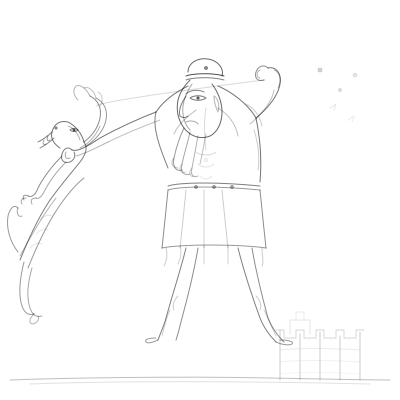
Two-thirds god, one-third mortal, a king who walked to the edge of death.He sought the secret of forever, and found instead the weight of being.
Domains

Role
Gilgamesh is the legendary king of Uruk and the protagonist of the oldest known epic in world literature. Described as two-thirds divine and one-third mortal, the son of the goddess Ninsun and the mortal Lugalbanda, he is a figure of superhuman strength and restless ambition whose story arc traces the most profound journey in ancient literature: from tyrannical arrogance, through the transformative power of friendship and grief, to a hard-won acceptance of human mortality. In the Sumerian King List, he appears as the fifth ruler of the First Dynasty of Uruk, credited with building the great walls of the city, a feat that serves as the epic's framing device and its final, quiet affirmation that lasting achievement, not personal immortality, is the proper measure of a life.
Significance
The Epic of Gilgamesh is the foundational work of world literature and one of the most important texts for understanding the intellectual and spiritual life of ancient Mesopotamia. It explores friendship, mortality, grief, the limits of human ambition, and the search for meaning in the face of inevitable death with a psychological depth and emotional honesty that resonates across four millennia. The relationship between Gilgamesh and Enkidu constitutes one of the earliest and most moving portrayals of profound friendship in literary history, and Gilgamesh's reaction to Enkidu's death, a frantic, grief-stricken refusal to accept the reality of loss, speaks to experiences that transcend cultural boundaries. The epic's conclusion, in which Gilgamesh returns to Uruk and finds consolation not in escaping death but in the enduring walls of his city, articulates a distinctly Mesopotamian humanism: the value of mortal life lies in what one builds and leaves behind.
Historical Context
Gilgamesh appears in the Sumerian King List as the fifth king of the First Dynasty of Uruk, and while the historical existence of a ruler by this name during the Early Dynastic period (ca. 2800-2500 BCE) is plausible, the literary Gilgamesh rapidly transcended any historical kernel. Separate Sumerian poems about his exploits, including "Gilgamesh and Huwawa," "Gilgamesh and the Bull of Heaven," "The Death of Gilgamesh," and "Gilgamesh, Enkidu, and the Netherworld," circulated independently during the Ur III and Old Babylonian periods. These disparate traditions were woven into a unified narrative by the scholar-scribe Sin-leqi-unninni during the late second millennium BCE, producing the Standard Babylonian Epic of Gilgamesh in twelve tablets. Fragments of the epic have been found across the ancient Near East, from Hattusa in Anatolia to Megiddo in the Levant, testifying to its extraordinary cultural reach.
Mythological Narratives
The Standard Babylonian Epic follows Gilgamesh through a series of transformative experiences. He and Enkidu journey to the Cedar Forest and slay its guardian Humbaba, an act of glory that also constitutes a transgression against divine order. They then kill the Bull of Heaven sent by the enraged Ishtar, but this second act of defiance provokes the gods to decree Enkidu's death. The death of Enkidu drives Gilgamesh into a desperate quest for immortality, taking him across the waters of death to find Utnapishtim, the sole mortal granted eternal life. In Tablet XI, Utnapishtim recounts the story of the great flood, a narrative that George Smith famously recognized in 1872 as a parallel to the biblical deluge story, causing a sensation in Victorian England. Utnapishtim reveals a plant of rejuvenation growing at the bottom of the sea; Gilgamesh retrieves it but a serpent steals it while he bathes, and he returns to Uruk empty-handed, his quest a failure in its stated aim but a triumph of self-knowledge.
Legacy
The recovery of the Gilgamesh epic from the library of Ashurbanipal at Nineveh in the mid-nineteenth century CE was one of the most significant archaeological discoveries in human history, fundamentally reshaping the modern understanding of ancient Near Eastern civilization and its relationship to the biblical tradition. Andrew George's comprehensive critical edition, published in 2003, established the definitive scholarly text and demonstrated the epic's extraordinary textual complexity and literary sophistication. Gilgamesh's influence extends far beyond Assyriology: his story has been recognized as a precursor to the Odyssey, as a parallel to the Adamic narrative, and as one of the earliest expressions of existentialist thought in world literature. The epic continues to be translated, adapted, and reinterpreted, a testament to the enduring power of a story first told on clay tablets more than four thousand years ago.
Symbols & Attributes
Connections
Ally of Enkidu Best friend and companion, created as his equal
Slayer of Humbaba Killed Humbaba, guardian of the Cedar Forest
Associated with Utnapishtim Sought Utnapishtim for the secret of immortality
Associated with Siduri Siduri counseled Gilgamesh on his journey
Associated with Nanna Gilgamesh's mother Ninsun was associated with Nanna's lineage
Rival of Inanna Gilgamesh rejected Inanna's advances, triggering her wrath and the Bull of Heaven episode
Associated with Utu Divine patron and protector of Gilgamesh on his quests
Featured in
Inanna and the Huluppu Tree
Inanna rescues a sacred huluppu tree from three sinister creatures, and with Gilgamesh's aid, the tree is felled to craft her throne and bed, while its remnants become the legendary pukku and mikku.
originskingshipdivine-gifts
Epic of Gilgamesh
The world's oldest epic. A king's journey from arrogance through friendship, loss, and a futile quest for immortality, ending in hard-won acceptance.
mortalityfriendshipquestlosskingship
Sources & References
- The Babylonian Gilgamesh Epic (2003)
- Myths from Mesopotamia (2000)
- The Sumerians: Their History, Culture, and Character (1963)