Hero
Utnapishtim
sumerian Ziusudra
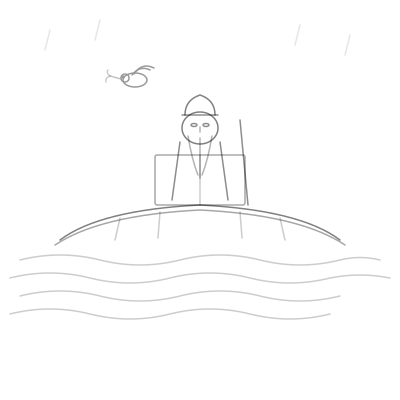
The one who found life beyond the flood.Alone among mortals, he was granted the gift that Gilgamesh could not hold.


Role
Utnapishtim is the Mesopotamian flood hero, the sole mortal granted immortality by the gods after surviving the great deluge that destroyed the world. In the Standard Babylonian Epic of Gilgamesh, he resides at the edge of the world, beyond the waters of death, a figure of profound narrative importance who serves as both the object of Gilgamesh's desperate quest and the deliverer of the epic's ultimate lesson about the human condition. His story represents the Mesopotamian account of the most catastrophic event in cosmic history: the moment when the gods resolved to annihilate the human race they had created, and the single act of divine mercy that preserved the seed of life from total extinction.
Significance
Utnapishtim embodies the paradox at the heart of the Gilgamesh epic: the one mortal who escaped death serves as the proof that immortality cannot be attained through human effort. His immortality was not earned through heroism or wisdom but granted as a unique, unrepeatable divine gift following the flood, an exception that confirms the rule that death is the universal destiny of humankind. When Gilgamesh reaches him after an exhausting journey across the waters of death, Utnapishtim challenges the hero to stay awake for six days and seven nights as a test of his worthiness for eternal life. Gilgamesh immediately falls asleep, failing spectacularly and demonstrating that even the greatest of mortal heroes cannot overcome the fundamental limitations of human nature. The theological message is clear: the boundary between mortal and divine is absolute and cannot be crossed by will or valor alone.
Mythological Narratives
In Tablet XI of the Standard Babylonian Epic, Utnapishtim narrates the flood story to Gilgamesh in vivid detail. Warned by Enki (Ea) through the wall of his reed hut, a cunning stratagem by which the god technically avoids breaking his oath of secrecy to the divine assembly, Utnapishtim constructs a massive vessel and loads it with his family, skilled craftsmen, and representatives of all living creatures. The storm rages for six days and seven nights, so terrible that even the gods cower in fear. When the waters recede and the vessel grounds on Mount Nimush, Utnapishtim sends out a dove, a swallow, and finally a raven; when the raven does not return, he knows the waters have receded and performs a sacrifice that draws the famished gods to its smoke like flies. Enlil is furious that anyone survived, but Ea rebukes him, and the chastened Enlil grants Utnapishtim and his wife eternal life, settling them at the edge of the world. The earlier Sumerian version names this figure Ziusudra, and in the Atrahasis epic he appears as Atrahasis ("Exceedingly Wise"), preserving variant traditions of the same foundational narrative.
Historical Context
The flood narrative has the deepest roots of any Mesopotamian literary tradition, appearing in Sumerian, Old Babylonian, and Standard Babylonian versions spanning more than a millennium of textual history. George Smith's identification of the flood tablet in 1872, when he was working through fragments from Ashurbanipal's library at the British Museum, caused an international sensation and fundamentally altered the relationship between biblical studies and ancient Near Eastern archaeology. Geological evidence suggests that catastrophic flooding in the alluvial plains of southern Mesopotamia, possibly including a major transgression of the Persian Gulf during the sixth millennium BCE, may have provided the historical kernel around which the flood traditions crystallized. The narrative was so deeply embedded in Mesopotamian cultural memory that the Sumerian King List treats the flood as a historical watershed, dividing all of history into antediluvian and postdiluvian periods and assigning fantastically long reigns to the kings who ruled before the deluge.
Legacy
Utnapishtim's flood narrative has had an incalculable impact on comparative mythology and the study of world literature. Its parallels with the biblical account of Noah in Genesis 6-9 are extensive and detailed, including the divine decision to destroy humanity, the warning to a single righteous man, the construction of a vessel, the sending of birds, and the post-flood sacrifice. These parallels have generated centuries of scholarly debate about the direction and nature of literary transmission between Mesopotamia and ancient Israel. The Atrahasis epic adds additional context by embedding the flood within a larger narrative about human population growth and divine strategies for controlling it, including plague and famine before the final resort to deluge. Utnapishtim thus stands at the center of one of the most enduring and widely distributed narrative traditions in human civilization, connecting the mythologies of Mesopotamia, the Levant, Greece, and South Asia through a shared memory of primordial catastrophe and survival.
Symbols & Attributes
Featured in
Epic of Gilgamesh
The world's oldest epic. A king's journey from arrogance through friendship, loss, and a futile quest for immortality, ending in hard-won acceptance.
mortalityfriendshipquestlosskingship
Flood of Utnapishtim
The gods send a devastating flood to destroy humanity. Enki secretly warns Utnapishtim, who builds an ark and survives, earning immortality from the repentant gods.
floodsurvivaldivine-judgment
Sources & References
- The Babylonian Gilgamesh Epic (2003)
- Myths from Mesopotamia (2000)
- The Sumerians: Their History, Culture, and Character (1963)