Hero
Enkidu
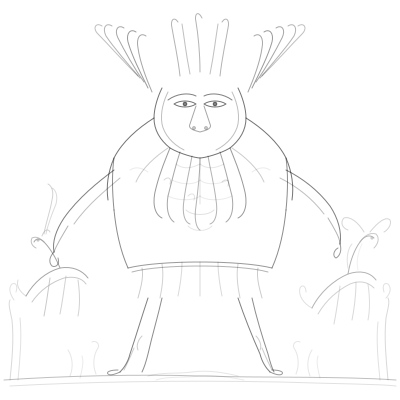
Born of the wild, shaped from clay and silence.He ran with the beasts until love made him human.
Domains
Role
Enkidu is the wild man created by the gods as a companion, counterbalance, and equal for the tyrannical king Gilgamesh. Fashioned from clay by the mother goddess Aruru and set down in the wilderness, he lives among the gazelles and wild animals, eating grass and drinking at watering holes, until the temple priestess Shamhat introduces him to the ways of human civilization. His transformation from beast-man to civilized hero constitutes one of the earliest and most profound literary meditations on the nature of humanity itself: what separates the human from the animal, and what is gained and lost in the transition from nature to culture. Once civilized, Enkidu becomes Gilgamesh's inseparable companion, and their friendship forms the emotional and thematic core of the epic.
Significance
Enkidu's narrative arc encodes the fundamental Mesopotamian tension between civilization and the wild. His creation from clay mirrors the creation of humanity in Mesopotamian myth, and his progression from animal existence through sexual initiation to civilized society represents a compressed version of the journey that Mesopotamian thinkers believed defined human development. After Shamhat's initiation, the animals that once accepted him as one of their own flee from his presence, a poignant detail that captures the irreversibility of civilized consciousness. Yet Enkidu's death, the central crisis of the epic, reveals that civilization's gifts, friendship, knowledge, heroic glory, are inseparable from mortality. His death is the price of the divine transgression committed when he and Gilgamesh killed Humbaba and the Bull of Heaven, establishing a tragic economy in which the greatest achievements of human life carry within them the seeds of loss.
Mythological Narratives
In the Standard Babylonian Epic, Enkidu's transformation occupies the first two tablets. After Shamhat initiates him over six days and seven nights, she leads him to a shepherds' camp where he learns to eat bread, drink beer, and wear clothing, each act marking a stage in his humanization. His arrival in Uruk and his wrestling match with Gilgamesh at the threshold of a bride's house establishes their bond through ritual combat, a motif common in heroic literature. Together they journey to the Cedar Forest and defeat Humbaba, and slay the Bull of Heaven. When the gods decree that one of them must die for these transgressions, Enkidu is chosen. His extended deathbed scene in Tablet VII, including his bitter curse against Shamhat (later retracted), his curse against the hunter who first discovered him, and his terrifying dream-vision of the underworld, constitutes one of the most emotionally wrenching passages in all of ancient literature.
Legacy
Enkidu's death and the grief it provokes in Gilgamesh drives the entire second half of the epic, transforming a heroic adventure into an existential quest. Gilgamesh's refusal to bury Enkidu's body until a worm drops from its nose is a detail of startling realism that captures the raw denial of early grief. The Sumerian composition "Gilgamesh, Enkidu, and the Netherworld" presents an alternative tradition in which Enkidu descends to the underworld alive to retrieve objects that have fallen through a hole in the ground, only to be trapped by the rules of the dead; his ghost later rises to report to Gilgamesh on the conditions of the afterlife, providing a rare direct account of Mesopotamian beliefs about what happens after death. Enkidu's dual nature as wild man and civilized hero has inspired extensive scholarly commentary, with Jacobsen, Oppenheim, and others reading him as a figure who embodies the ambiguous blessings of culture and the inescapable tragedy of mortal consciousness.
Symbols & Attributes
Connections
Sources & References
- The Babylonian Gilgamesh Epic (2003)
- Myths from Mesopotamia (2000)