Hero
Etana
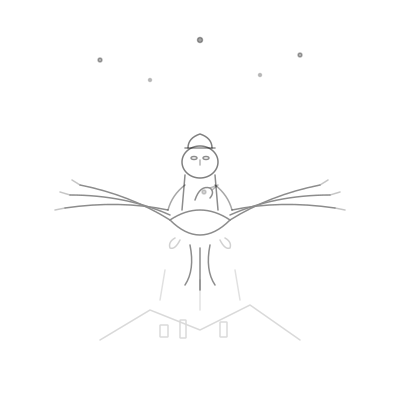
The shepherd who rode the eagle to heaven's gate.Seeking the plant of birth, he dared the sky and fell.
Role
Etana is a legendary king of Kish and one of the earliest named rulers in the Sumerian King List, which describes him as "a shepherd, the one who ascended to heaven, the one who consolidated all the lands." He is the protagonist of the "Myth of Etana," one of the oldest narrative compositions in Mesopotamian literature, in which a childless king ascends to heaven on the back of an eagle in search of the "plant of birth" that will enable him to produce an heir. The myth is attested in Old Babylonian, Middle Assyrian, and Standard Babylonian versions, indicating its enduring popularity across more than a millennium. Etana's story sits at the intersection of kingship ideology and the human desire to transcend mortal limitations, making it one of the most thematically rich narratives in the Mesopotamian literary canon.
Significance
Etana's myth explores the limits of human ambition, the boundary between the mortal and divine realms, and the theological politics of legitimate kingship. After the great flood, the gods establish kingship as the institution that will maintain order in the human world, and Etana is chosen as one of the first kings. Yet kingship itself is imperiled when Etana cannot produce an heir, creating a crisis that threatens the divine plan for human governance. His ascent to heaven is both a heroic act and a transgression: mortals are not meant to enter the celestial realm, and the narrative tension derives from the question of whether the gods will permit this violation of cosmic boundaries for the sake of preserving the institution they themselves created. The myth thus interrogates the paradox of divine-human relations: the gods need human kings to maintain order, but the very institution of kingship may require mortals to reach beyond their appointed station.
Mythological Narratives
The myth opens with a fable about an eagle and a serpent who swear an oath of friendship before Shamash, the god of justice. The eagle betrays the oath by devouring the serpent's young, and Shamash instructs the serpent to hide inside a dead ox. When the eagle lands to feed, the serpent seizes it, breaks its wings, and casts it into a pit. Meanwhile, Etana prays daily to Shamash for the plant of birth, and the sun god directs him to the pit where the eagle lies crippled. Etana nurses the eagle back to health, and in gratitude the eagle carries him skyward toward the heaven of Anu, where the plant of birth is kept. The ascent is described in vivid, vertiginous detail: with each stage, the earth shrinks below them until the sea appears as a mere garden plot and the land as a bread trough. At the highest point, Etana's courage fails, or the eagle's strength gives out, and the pair plummet earthward. The text is fragmentary at this critical point, but the Sumerian King List credits Etana with a son and successor, suggesting that the quest ultimately succeeded.
Legacy
Etana's heavenly ascent is one of the oldest flight narratives in world literature, predating the Greek myth of Icarus by well over a millennium. Cylinder seal impressions from the Akkadian period (ca. 2334-2154 BCE) depicting a human figure riding an eagle are among the earliest visual representations of a literary narrative in Mesopotamian art, confirming the myth's popularity in the third millennium BCE. The fable of the eagle and the serpent, which frames the Etana narrative, belongs to a tradition of animal fables that scholars have connected to the later Aesopic tradition, suggesting possible channels of literary transmission from Mesopotamia to Greece. The myth's emphasis on the legitimacy and continuity of kingship reflects its function as a political-theological text, one that justified the institution of monarchy by grounding it in divine necessity while simultaneously acknowledging its fragility and dependence on cosmic forces beyond human control.
Symbols & Attributes
Connections
Sources & References
- Myths from Mesopotamia (2000)
- ORACC (Open Richly Annotated Cuneiform Corpus) Visit