Deity
Ninurta
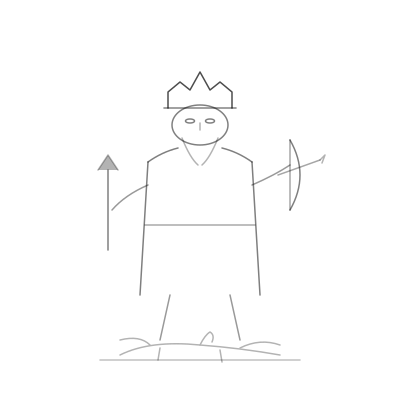
Champion of the gods, who hunts the monsters at the edge of order.His plow turns the earth; his mace breaks the mountain.
Role
Ninurta is the god of war, agriculture, hunting, and heroic combat, the son of Enlil and one of the most important warrior deities in the Sumerian and Akkadian pantheon. He embodies the paradox of civilization itself: the same strength that defeats chaos and defends cosmic order also breaks the earth and makes it yield its harvest. Ninurta is the divine champion who confronts monstrous threats at the boundaries of the ordered world, a role that makes him the mythological prototype for later hero-gods throughout the ancient Near East. His dual nature as warrior and farmer reflects the Mesopotamian understanding that the maintenance of civilization requires both military defense against external threats and the sustained agricultural labor that feeds the population.
Significance
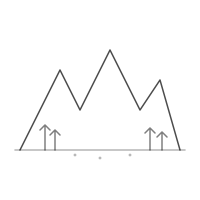
Ninurta's myths celebrate the triumph of civilized order over primordial chaos in some of the most vivid and dramatic compositions in Sumerian literature. In "Lugal-e" (also known as "Ninurta's Exploits"), he battles and defeats the Asag demon and its army of stone warriors in the mountains, then reorganizes the landscape by creating the Tigris river system to drain the floodwaters and constructing a great stone levee (the hursag) from the bodies of his defeated enemies, which he presents to his mother Ninhursag. This narrative encodes the practical reality of Mesopotamian irrigation engineering within a mythological framework, depicting the taming of wild waters as a divine act of heroism. In the "Anzu" myth (also attributed to Ningirsu in some traditions), Ninurta recovers the Tablet of Destinies stolen from Enlil by the monstrous Anzu bird, restoring cosmic order through single combat.
Cult & Worship
Ninurta was worshipped under the closely related name Ningirsu at the E-ninnu ("House of Fifty") temple in Girsu (modern Tello), where Gudea, the famous ensi (ruler) of Lagash in the late third millennium BCE, undertook an elaborate rebuilding program documented in the "Cylinders of Gudea," two of the longest and most detailed Sumerian literary compositions known. These texts describe Gudea's divinely inspired dream, his consultation with the goddess Nanshe, and the meticulous construction of the temple according to divine specifications, providing invaluable information about Sumerian temple architecture, ritual practice, and theological thought. In the Neo-Assyrian period, Ninurta became especially important at the city of Kalhu (modern Nimrud), where Ashurnasirpal II dedicated a major temple to him during the ninth century BCE. Assyrian kings identified strongly with Ninurta as the divine warrior, and his image was prominent in the sculptural programs of Assyrian palaces.
Mythological Narratives
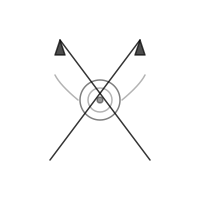
The "Anzu" myth, preserved in both Old Babylonian and Standard Babylonian versions, narrates how the monstrous lion-headed eagle Anzu stole the Tablet of Destinies from Enlil while the chief god was bathing, plunging the cosmos into disorder. After other gods refuse the dangerous mission, Ninurta volunteers and, after initially failing when his arrows are turned back by the Tablet's power, devises a strategy to cut Anzu's wings and recover the divine artifact. The "Ninurta and the Turtle" composition adds a darker note to his character: after recovering the me from Enki's abzu, Ninurta grows arrogant, and Enki creates a giant turtle that drags the warrior god into a pit, humbling him. These narratives collectively portray Ninurta as a figure of immense power and courage who nevertheless operates within a divine order that checks even the mightiest champion from overstepping his appointed role.
Symbols & Attributes
Connections
Sources & References
- Gods, Demons and Symbols of Ancient Mesopotamia (1992)
- ETCSL (Electronic Text Corpus of Sumerian Literature) Visit